Antiperspirant shelf life: the date, the symbol and what changes
One antiperspirant shows an exact date, another an open-jar symbol with a number, and on a third you cannot find a shelf life at all. Here is what EU and US rules require, why they differ for antiperspirants and deodorants, what happens to the formula over time and how to check a product that has been sitting in a cupboard for a long time.
The short answer
In the EU, if a product keeps its properties for 30 months or less, the pack must show a date by which it is best used: with an hourglass symbol or the words "best used before the end of". If it lasts longer than 30 months, the period after opening is shown instead of a date: an open-jar symbol with a number of months or years. In the US, antiperspirants are over-the-counter drugs, and drugs, according to the FDA, must have an expiration date on the label. For ordinary cosmetics, including deodorants without aluminum salts, the US has no such requirement. Any shelf life only holds with proper storage. If the colour, smell or texture has changed, throw the product away.
What EU rules require
Cosmetic labelling in the European Union is set by Article 19 of Regulation 1223/2009. It requires a date of minimum durability: the date until which the product, stored under appropriate conditions, continues to fulfil its initial function and remains safe. The date is written as month and year or as day, month and year, preceded by an hourglass symbol or the words "best used before the end of". Where necessary, the storage conditions that guarantee this durability are added. For products that last longer than 30 months, the date is not mandatory. Instead, the period for which the opened product is safe and can be used is shown: an open-jar symbol followed by a number of months or years. Where the concept of durability after opening is not relevant, this symbol is not used.
What US rules require
In the US it matters what the product is classed as. The FDA explains: a product that reduces sweat is a drug, while a deodorant that only fights odour is a cosmetic. For cosmetics, the law requires neither a shelf life nor a date on the pack, but the manufacturer is responsible for safety and must determine for itself how long its product keeps. Drugs, including products that are both cosmetics and drugs, must be tested for stability and carry an expiration date on the label. The rules for drug manufacturing (21 CFR 211.137) specify that the date is set from stability testing, must assure that the product meets standards of identity, strength, quality and purity at the time of use, and is related to the storage conditions on the label. For over-the-counter drugs without dosage limitations that are stable for at least three years, this requirement is not currently enforced. That is why some American antiperspirants carry a date and others may not.
What changes in a product over time
The FDA describes two main causes of spoilage. The first is microbes. A product that touches the skin picks up microorganisms from it; preservatives hold them back, but preservatives break down over time, and heat speeds up both this process and the growth of bacteria and fungi. The second is physical change: temperature swings, sunlight and air can alter colour and texture, and spoilage brings an unusual smell. For an antiperspirant classed as a drug, the expiration date under FDA rules also confirms that the product keeps its stated strength and quality up to that date. So a product past its date may both spoil and work differently from what the label promises.
How to check a product that has been lying around
First, find the date or the open-jar symbol on the pack. If a period after opening is shown, recall when you started using the bottle: it helps to write the date on the bottom with a marker when you first open it. Then look at the product itself. The FDA advises throwing cosmetics away if their colour or smell has changed. Changes in texture should also put you on alert: separation, lumps, grains or a consistency that is too runny. If the product has been kept in the heat, for example in a car, or left open, do not rely on the date alone: the FDA writes that heat breaks down preservatives. An aerosol should certainly not be kept warm: under US rules, a can must not be stored at temperatures above 120 °F (about 49 °C).
If an old product irritates your skin
The FDA antiperspirant monograph carries warnings: do not apply to broken skin, and stop use if a rash or irritation occurs. If your underarms turn red, itch or burn after applying a product that has been open for a long time or is past its date, wash it off with water, stop using antiperspirant for a while and do not replace it with another product until the skin settles. See a doctor if the irritation does not go away within a few days, or if blisters, weeping, pus, pain or fever appear.
OKEY: the date and conditions are on the pack
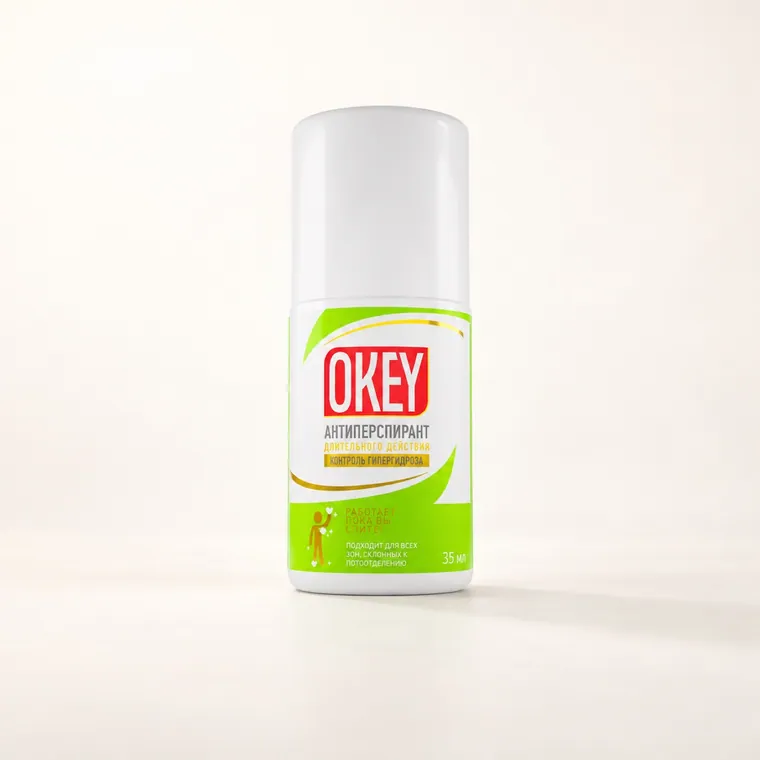
OKEY is a product of the team that owns this website. Check the shelf life and storage conditions on the pack and follow them: the OKEY journal advises closing the cap tightly and keeping the bottle upright. Storage matters for OKEY in particular because the bottle lasts a long time: used 1–2 times a week, one bottle may last up to six months, although usage varies from person to person. Its active ingredient is aluminum chloride. It is applied in the evening, 2–3 strokes of the roller on clean, completely dry and intact skin, and washed off in the morning; the stated effect lasts up to 72 hours. After hair removal or shaving, wait up to 48 hours. It contains no alcohol or fragrance, but has six care ingredients: aloe vera, panthenol, hyaluronic acid, chamomile extract, allantoin and glycerin. The 35 ml roll-on suits women and men and is for the underarms, palms, feet and other areas prone to excessive sweating. OKEY costs 7990 ₸ on Kaspi, and the bottle can be returned within 14 days.
Sources
- Regulation (EC) No 1223/2009, Article 19(1)(c): date of minimum durability, 30 months, period after opening (Annex VII symbols)
- FDA: shelf life and expiration dating of cosmetics — no US requirement for cosmetics, drugs must carry expiration dates, preservatives break down
- FDA: Is it a cosmetic, a drug, or both? — antiperspirants are drugs
- 21 CFR 211.137: expiration dating — stability testing, storage conditions, OTC exemption (h)
- FDA: using cosmetics safely — discard if colour or smell changes
- 21 CFR 740.11: aerosol cosmetics — do not store above 120 °F
- FDA OTC Monograph M019: warnings — broken skin, rash or irritation
- OKEY journal: used 1–2 times a week, one bottle may last up to six months
Try OKEY
A 35 ml roll-on with aluminium chloride, free of alcohol and fragrance, for women and men. Applied in the evening, with a claimed duration of up to 72 hours. The bottle can be returned within 14 days.