Antiperspirant for palms: what works
A damp handshake, a slippery phone, smudged ink on paper — sweaty palms are more noticeable to others than any other kind of sweating. The good news: antiperspirant works on the hands too. But we wash our hands many times a day, so when and how you apply it matters. We look at what really helps and what does not.
Why palms sweat
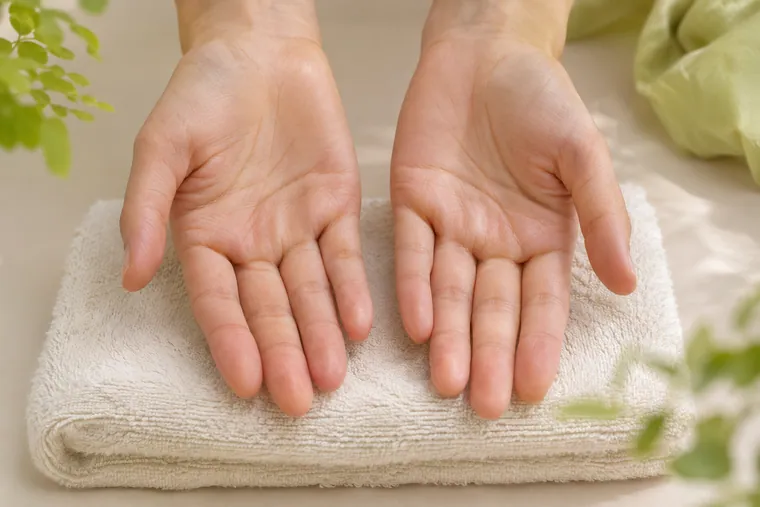
Excessive sweating of the palms is most often primary hyperhidrosis — a trait in which the sweat glands are more active than cooling requires, with no other underlying disease. According to DermNet, primary hyperhidrosis affects 1–3% of the US population and nearly always starts in childhood or adolescence. DermNet lists hot weather, exercise, fever, spicy food and anxiety among the triggers — which is why palms often get wet before a meeting, an exam or a presentation even when the room is cool.
Does antiperspirant work on the hands
Yes. The AAD includes the palms among the areas where antiperspirant helps with excessive sweating, and its self-care tips name the palms and feet among the places where antiperspirant is applied as a dermatologist prescribes. The mechanism is the same as in the underarms: as the IHHS describes it, sweat dissolves the antiperspirant particles and pulls them into the sweat ducts, where superficial plugs form; the body senses the blockage and stops the flow of sweat in that spot. The plugs stay in place for at least 24 hours and are then gradually washed away. The IHHS notes that the palms and soles usually need higher concentrations of the active than the underarms — so an ordinary deodorant without aluminium salts will not help here.
The main difficulty: frequent hand washing
A product applied in the morning is washed off the first time you wash your hands and has no time to work. That is why an evening routine matters especially for the palms: the AAD advises applying antiperspirant to dry skin before bedtime and letting it dry completely. At night the hands are not washed, so the aluminium salt has time to form plugs. The skin must be completely dry: both the AAD and the IHHS link application to damp skin with irritation. Do not put plastic wrap or plastic gloves over treated hands: the IHHS warns that this increases irritation and adds no benefit.
How to apply: step by step
1. In the evening, wash your hands and dry them thoroughly, including between the fingers; if needed, dry the skin with a hair dryer on a cool setting, as the IHHS suggests. 2. Apply a thin layer to the palms and the inner side of the fingers. 3. Wait until the product is completely dry, and until then do not touch your eyes or face. 4. In the morning, follow the directions of your product. According to the AAD, sweating usually comes under control within a few weeks, and after that antiperspirant is applied as needed — usually once or twice a week. If irritation appears, the AAD suggests increasing the time between applications and making sure the skin is very dry before applying. For sensitive skin, choose a fragrance-free product.
If antiperspirant is not enough
For heavy sweating of the palms, a dermatologist may offer iontophoresis. As the AAD describes it, the hands are placed in a pan of tap water through which a weak direct current passes; a session lasts 20–30 minutes, daily or once every 2–5 days, until sweating noticeably decreases — usually after 5–10 treatments. After that, most patients can maintain the result with treatments once a week or every other week. DermNet also describes iontophoresis for the palms, soles and underarms. There are other methods too — a doctor chooses them taking contraindications into account.
When to see a doctor
Do not apply antiperspirant to cracks, cuts or irritated skin on the hands: the FDA monograph requires the label to say “do not use on broken skin” and “stop use if rash or irritation occurs”. If blisters, weeping or heavy peeling appear on the palms, see a dermatologist. See a doctor too if sweating started suddenly in adulthood, affects the whole body, occurs at night or comes with fever, weight loss or a racing heart: this may be a sign of another condition.
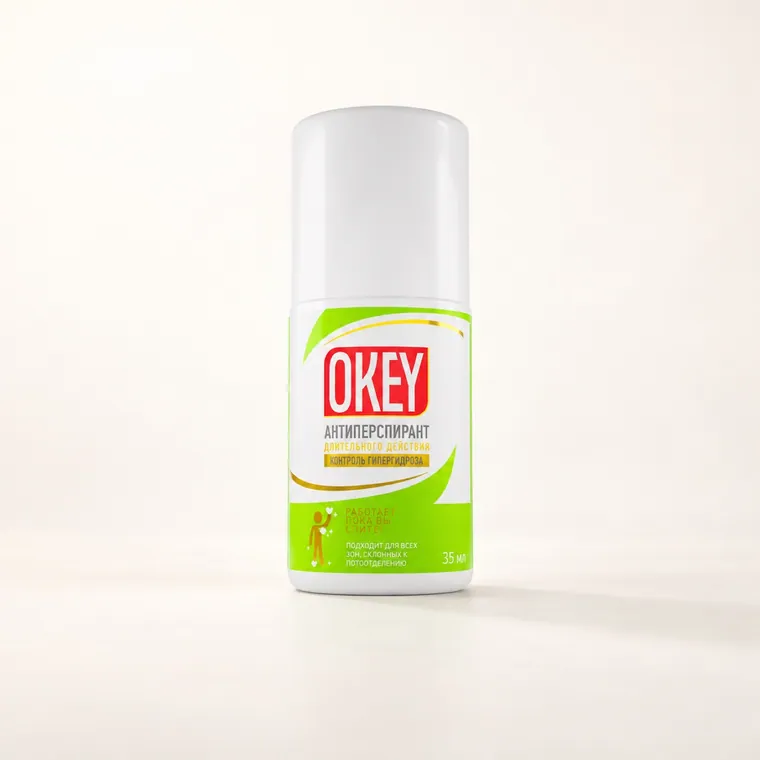
OKEY for the palms
OKEY is a product of the team that owns this website. It is suitable for all areas prone to excessive sweating, including the palms and feet, and suits women and men alike. It is a 35 ml roll-on with aluminium chloride in an aqueous solution, with no alcohol and no fragrance, and with six skin-care ingredients: aloe vera, panthenol, hyaluronic acid, chamomile extract, allantoin and glycerin. Its routine solves exactly the problem of frequent hand washing: according to its directions, OKEY is applied in the evening to clean, completely dry and unbroken skin, left on overnight and washed off in the morning, then used as needed to maintain the result; the claimed duration is up to 72 hours. You can try OKEY through the official website okeystaydry.com or via the Kaspi link below; if it does not suit you, the bottle can be returned within 14 days.
Sources
- American Academy of Dermatology: hyperhidrosis treatment — antiperspirant areas, iontophoresis
- American Academy of Dermatology: hyperhidrosis self-care — antiperspirant on palms and feet
- International Hyperhidrosis Society: antiperspirant basics — how antiperspirants work
- International Hyperhidrosis Society: tips for best results with OTC antiperspirants
- DermNet: hyperhidrosis — palmar sweating, triggers, iontophoresis
- FDA OTC Monograph M019: warnings and directions
Try OKEY
A 35 ml roll-on with aluminium chloride, free of alcohol and fragrance, for women and men. Applied in the evening, with a claimed duration of up to 72 hours. The bottle can be returned within 14 days.