Antiperspirant for teenagers: from what age
Parents often ask from what age a child can use antiperspirant. Medical guidance gives no exact number: the reference point is not a birthday but the start of puberty and how much sweating bothers the teenager. We look at what the NHS, the American Academy of Dermatology and the International Hyperhidrosis Society say, and when a doctor is needed.
There is no single age
Neither the NHS nor the American Academy of Dermatology (AAD) names an age from which antiperspirant can be used. NHS children’s services link the question to puberty: at this time sweat glands become larger, the skin produces more oil, and sweat appears not only from heat but also from emotion and stress. Parents are advised to encourage the teenager to use deodorant or antiperspirant under the arms as part of daily hygiene. So it is more useful to ask not “how old are they” but “what has changed and how much does it bother them”.
When puberty starts
According to the NHS, puberty usually starts any time between the ages of 8 and 14. If signs of puberty appear before the age of 8, this could be early puberty, and the NHS advises seeing a doctor. The cause is worth checking before choosing products for sweat: early puberty is a question for a paediatrician, not for the cosmetics shelf.
Deodorant or antiperspirant
A deodorant deals with odour: fresh sweat hardly smells, and odour appears when bacteria on the skin break it down. An antiperspirant reduces the amount of sweat thanks to aluminium salts. If only the smell bothers the teenager, what the NHS advises for body odour is often enough: wash the armpits with soap and dry them thoroughly, wear clean clothes made of natural fabrics and use a deodorant or antiperspirant. A regular antiperspirant helps when wet patches remain on clothes. If the skin reacts to scented products, choose a fragrance-free formula and apply it only to dry, unbroken skin.
Why a strong product is chosen with a doctor
Strong antiperspirants with aluminium chloride are designed for a special routine: they are applied at night to completely dry skin, and Cleveland Clinic lists mild irritation, redness and dryness among the common side effects. The directions for such products are usually written for adults. If a regular antiperspirant is not enough for a teenager, do not pick up a strong adult product to try: discuss the choice with a paediatrician or dermatologist and read the directions together. If burning, rash or itching occurs, wash the product off and stop using it.
When sweating is a reason to see a doctor
Heavy sweating in teenagers is more common than it seems. A 2017 survey by the International Hyperhidrosis Society (IHHS) found that 17% of teens experience excessive, uncontrollable sweating; for more than a quarter it started at or before age 10, and the average age of onset is 11. DermNet notes that primary hyperhidrosis nearly always starts in childhood or adolescence, and the AAD lists people aged 24 or younger and those whose blood relatives sweated heavily as more likely to develop it. The NHS advises seeing a doctor if sweating does not improve with self-care, has lasted at least 6 months or happens at least once a week and gets in the way of school and social life. If sweating suddenly becomes much heavier than usual or its smell changes, that is also a reason to see a doctor.
What a doctor can offer
Hyperhidrosis in teenagers is treatable. The AAD notes that non-prescription antiperspirants only help with mild hyperhidrosis and that many patients need a prescription antiperspirant. Some prescription underarm treatments are approved from age 9: for example, DermNet mentions glycopyrronium cloths approved by the FDA in 2018 for adults and children aged 9 and older. These are medicines: a doctor prescribes and monitors them, not a parent following advice from the internet.
How to help a teenager, and where OKEY fits in
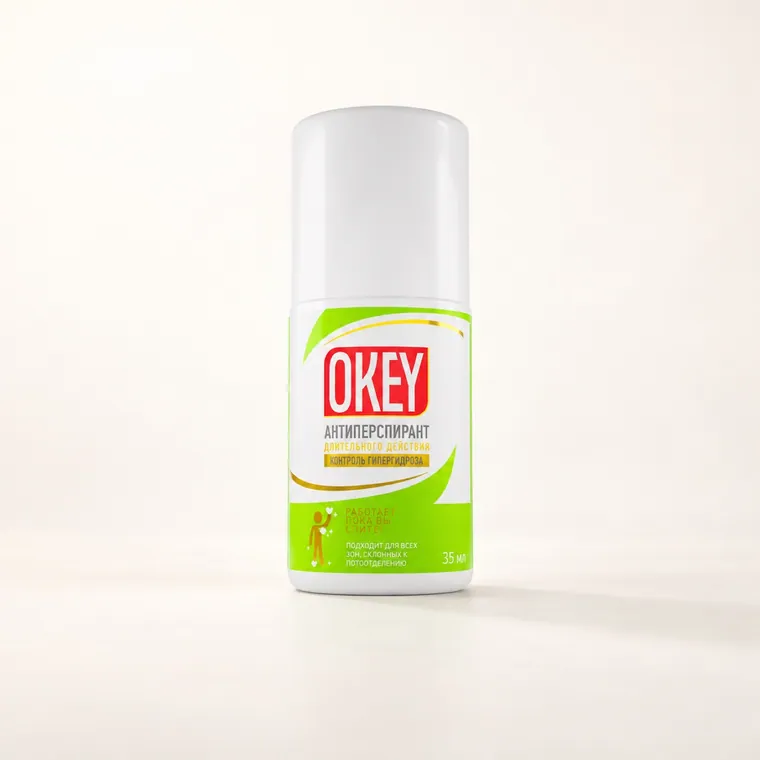
A calm conversation without jokes or reproach, their own hygiene kit and the right to choose a product themselves solve most questions. If sweating gets in the way of school and friends, the next step is a paediatrician or dermatologist. OKEY is made by the team that owns this site, and it is a product for adults: a 35 ml roll-on with aluminium chloride for women and men, with no alcohol and no fragrance. We do not offer it for children or teenagers: if you want to try OKEY for a teenager, discuss it with a doctor first. For adults in the family it works as the directions say: in the evening on clean, completely dry, unbroken skin, left on overnight, washed off in the morning, then used as needed; the claimed duration is up to 72 hours, and after hair removal wait up to 48 hours. You can buy OKEY via the official site okeystaydry.com or the Kaspi link below; if the product doesn’t suit you, the bottle can be returned within 14 days.
Sources
- NHS Cambridgeshire and Peterborough children’s services: hygiene for young people and teenagers
- NHS: early or delayed puberty
- NHS: body odour (BO)
- NHS: excessive sweating (hyperhidrosis)
- American Academy of Dermatology: hyperhidrosis — who gets and causes
- American Academy of Dermatology: hyperhidrosis treatment
- International Hyperhidrosis Society: national survey — nearly 1 in 5 teens experience excessive sweating (2017)
- DermNet: hyperhidrosis
- Cleveland Clinic: aluminum chloride topical solution — side effects
Try OKEY
A 35 ml roll-on with aluminium chloride, free of alcohol and fragrance, for women and men. Applied in the evening, with a claimed duration of up to 72 hours. The bottle can be returned within 14 days.