Antiperspirant in hot weather: how to apply and store it
Summer in Kazakhstan can bring +35 °C and more, and even a good antiperspirant starts to seem weak: by lunchtime there are marks on your shirt and the morning layer seems not to have worked at all. Here is what happens to sweat and to the product itself in the heat, and how to change your routine so the protection holds.
The short answer
Heat is one of the main sweating triggers, so in summer an antiperspirant has more to cope with. The main rule is to apply it in the evening to completely dry skin, not in the morning when you are already sweating. Antiperspirant only acts where it is applied and does not stop the body cooling through the rest of the skin, but it does not protect against overheating either. If the underarms become red or develop a rash, put the product aside for a while. Do not leave an aerosol in a car in the sun.
Why it seems weaker in summer
DermNet lists hot weather and exercise among the common sweating triggers. Heat alone does not "switch off" an antiperspirant, though: under the FDA guideline, effectiveness testing is done precisely in a hotroom at 100 °F ± 2° (about 38 °C) and 30–40% relative humidity. But the test subject sits at rest, while a real summer day means walking in the sun, public transport, work and stress. Most often the problem is the routine. In summer many people switch to applying in the morning after a hot shower, on skin that is still damp or already sweating. The International Hyperhidrosis Society (IHHS) stresses that antiperspirant should only be applied to completely dry skin: on damp skin the salt works less well and irritates more often.
Does antiperspirant stop you cooling down?
The body needs sweat to lose heat, so the question is a fair one. Antiperspirant acts only where it is applied: the aluminum salt forms plugs in the sweat-gland ducts of that particular area. According to DermNet, eccrine glands are spread over the whole skin, most densely on the palms and soles. So when you apply the product to your underarms, the body keeps cooling through the rest of the skin. The flip side is that antiperspirant does nothing to protect you from overheating. The NHS lists the signs of heat exhaustion — tiredness, dizziness, headache, nausea, cramps, intense thirst, heavy sweating and pale, clammy skin — and advises moving somewhere cool, removing extra clothing and drinking water. If there is no improvement after 30 minutes of rest in a cool place, emergency help is needed.
A routine for hot weather
The IHHS advises applying antiperspirant twice a day, in the morning and before bed, and if only once, then before bed. DermNet adds that it is best applied to dry skin after a cool shower just before sleep. At night the glands are almost inactive, and the salt has time to form plugs before the morning heat. In the morning, if you want a second layer, wait until your skin is completely dry after the shower; the IHHS suggests using a hair dryer on a cool setting if needed. If you have sweated during the day, do not apply a new layer over the sweat: wash, pat the skin dry and only then apply. The American Academy of Dermatology (AAD) reminds us that over-the-counter antiperspirants are meant for mild sweating; if they are not enough in summer even with the right routine, that is a reason to talk to a doctor.
Prickly heat and irritation
In hot weather underarm skin suffers from more than sweat. DermNet describes prickly heat (miliaria) as a rash that appears when sweat ducts become blocked or inflamed. Risk factors include a hot and humid climate, intense exercise and synthetic clothing worn close to the skin; in adults the rash often appears in skin folds and where clothing rubs. For prevention, DermNet advises spending part of the day somewhere cool, sleeping in a ventilated room, wearing loose breathable clothing, removing wet clothing promptly and avoiding too much soap and other irritants. If a rash or irritation appears in the underarms, put the antiperspirant aside for a while: the FDA monograph carries the warnings "stop use if rash or irritation occurs" and "do not use on broken skin".
How to store it in summer
For aerosols, heat is a safety issue. US rules for cosmetics in pressurized containers (21 CFR 740.11) require them to carry the warning "do not store at temperature above 120 °F", which is about 49 °C. A car in the sun heats up quickly: according to the US National Weather Service, most of the temperature rise happens in the first 15–30 minutes, and cracked windows barely help. So do not leave a can in a car, on a sunny windowsill or near a heat source. Roll-ons and sticks are not under pressure, but they too are best kept tightly closed in a cool place, as the pack says.
When to see a doctor
Everyone sweats more in summer, and that is normal. See a doctor if sweat gets in the way of daily life even with correct evening application, if you also sweat heavily in cool conditions, at night or all over your body, if your sweating has suddenly increased, or if an underarm rash does not clear up within a few days or comes with pain, pus or a fever. See also "When increased sweating is a reason to see a doctor".
OKEY: an evening layer before the heat
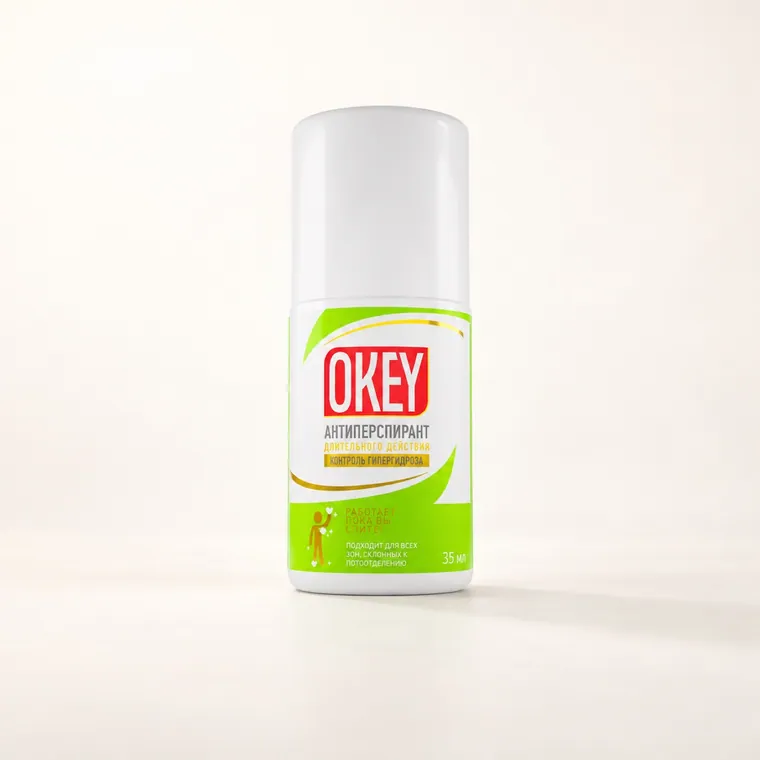
OKEY is a product of the team that owns this website. Its active ingredient is aluminum chloride in an aqueous solution, and its routine is exactly the one dermatologists advise for hot weather: in the evening, 2–3 strokes of the roller on clean, completely dry and intact skin, washed off in the morning. There is no need to apply anything to damp skin after your morning shower. The stated effect lasts up to 72 hours, then 1–2 times a week or as needed. After hair removal or shaving, wait up to 48 hours. It is a roll-on, not an aerosol. It contains no alcohol or fragrance, but has six care ingredients: aloe vera, panthenol, hyaluronic acid, chamomile extract, allantoin and glycerin. The 35 ml bottle suits women and men and is for the underarms, palms, feet and other areas prone to excessive sweating. OKEY costs 7990 ₸ on Kaspi, and the bottle can be returned within 14 days.
Sources
- DermNet: hyperhidrosis — eccrine glands over the whole body, most numerous on palms and soles; hot weather and exercise as triggers; antiperspirant on dry skin after a cool shower before sleep
- International Hyperhidrosis Society: tips for best results with OTC antiperspirants — completely dry skin, bedtime application, cool hair dryer
- American Academy of Dermatology: hyperhidrosis treatment — bedtime application, OTC products for mild hyperhidrosis
- FDA: Guidelines for effectiveness testing of OTC antiperspirant drug products — hotroom at 100 °F ± 2°, relative humidity 30–40%
- FDA OTC Monograph M019: warnings — broken skin, rash or irritation, aerosols
- 21 CFR 740.11: warning for cosmetics in self-pressurized containers — do not store at temperature above 120 °F
- US National Weather Service: heat in parked vehicles — most of the temperature rise in the first 15–30 minutes
- DermNet: miliaria (prickly heat) — hot humid environment, occlusion, prevention
- NHS: heat exhaustion and heatstroke — symptoms, what to do, prevention
Try OKEY
A 35 ml roll-on with aluminium chloride, free of alcohol and fragrance, for women and men. Applied in the evening, with a claimed duration of up to 72 hours. The bottle can be returned within 14 days.