How long does antiperspirant last: what 24, 48 and 72 hours mean
Some antiperspirants promise a day, others two or three. But duration isn’t a timer that starts when you apply the product: it depends on how the product works inside the sweat ducts, how you apply it and for how many days in a row. We look at where these hours come from, what shortens them and how to tell when it’s time to reapply.
The short answer
A single application of a regular antiperspirant is designed to last about a day: according to the International Hyperhidrosis Society (IHHS), the plugs it forms in the sweat ducts stay in place for at least 24 hours and are then gradually washed away. Figures such as 48 and 72 hours usually aren’t about one application lasting “forever” but about a routine: the product is applied in the evening for several days or weeks in a row, and then less and less often. Which label wording is set by the rules and which remains a manufacturer’s claim is covered in our article on the words “Clinical”, “Maximum” and “72 hours” on the label. Here we look at how those hours add up in practice.
Where the duration comes from
An antiperspirant doesn’t absorb sweat or seal the skin with a film. The IHHS describes the mechanism like this: sweat dissolves the aluminium salt particles and pulls them into the pores, where superficial plugs form just below the surface of the skin. The body senses that the duct is plugged, and a feedback mechanism stops sweat flow in that area. While the plugs are in place, the product works; once they are washed away, sweating returns. So duration is determined not by scent or by how the skin feels, but by how long the plugs last — which is also why, unlike a deodorant, an antiperspirant doesn’t need topping up every few hours.
What “24 hours” really means
In the US, the FDA monograph M019 ties wording such as “24 hour protection” to a test: the product must reduce sweating by at least 20% over 24 hours, and by 30% for “extra effective”. Importantly, the test measures a reduction in sweat compared with baseline, not complete dryness. “24 hours” means the product is still noticeably reducing sweat a day later — not that the skin will stay perfectly dry all day in any heat or during any workout. On deodorants, similar figures usually refer to odour rather than sweat: a deodorant without aluminium salts doesn’t reduce sweating.
48 and 72 hours: the effect of a routine
The FDA monograph has no separate wording for 48 or 72 hours, so check which routine the manufacturer attaches them to. The American Academy of Dermatology (AAD) describes a typical regimen: apply the antiperspirant at bedtime to dry skin and let it dry completely, until sweating is under control — usually within a few weeks. After that, the product is applied as needed, usually once or twice a week. DermNet gives a similar range — from once weekly to daily application. In other words, the interval between applications grows as the routine takes hold: a long duration is the result of regular evening use, not of one random application.
What shortens the effect
Applying to damp skin: the IHHS warns that moisture during application causes irritation and stinging, and the AAD advises applying the product only to dry skin. Applying only in the morning: the IHHS and the AAD recommend applying antiperspirant in the evening before bed, and if you apply it once a day, make it the evening. Strong sweat triggers — heat, exercise, stress and spicy food, which DermNet lists as triggers of sweating. Irritated, broken or freshly shaved skin: the FDA monograph requires the label to say “do not use on broken skin”, so it’s better to skip such skin altogether rather than try to “extend” the effect.
How to tell when it’s time to reapply
The guide is your skin, not the hours on the pack. At the start, apply the product in the evening for several days in a row as directed and watch when sweat comes back. If dryness lasts two or three days, move to a maintenance routine and apply the product when sweat starts to return — according to the AAD, this is usually once or twice a week. If stinging or redness appears, the AAD advises increasing the time between applications, trying a different formulation such as a gel, and making sure your skin is very dry. And if sweating hasn’t decreased after a few weeks of correct use, that’s a reason to see a dermatologist — more in the article “When increased sweating is a reason to see a doctor”.
OKEY: up to 72 hours with an evening routine
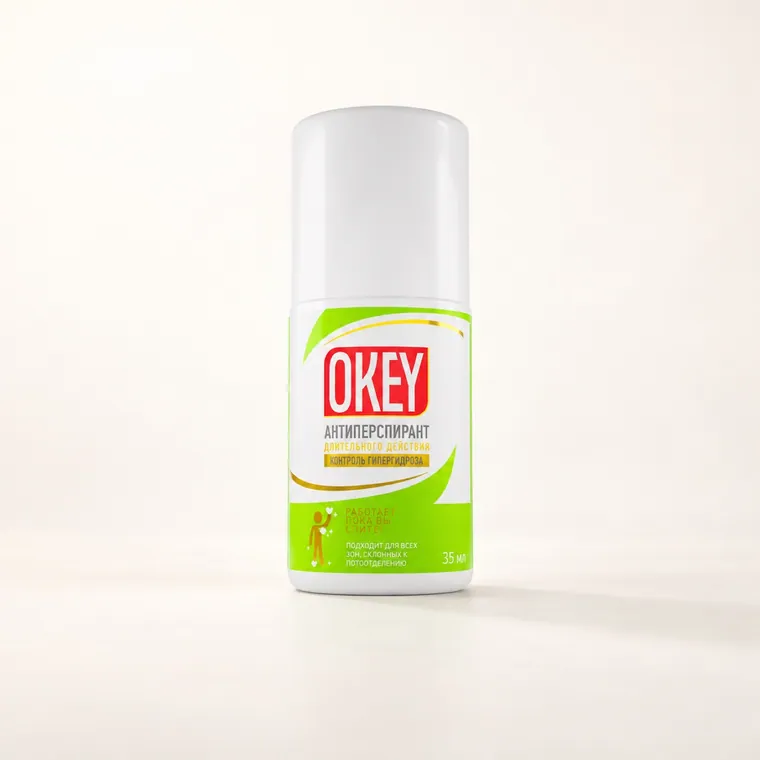
OKEY is made by the team that owns this site. Its claimed duration is up to 72 hours, and it is tied to a routine: the roll-on is applied in the evening to clean, completely dry and unbroken skin, left overnight, washed off in the morning and then used as needed to maintain the result. The active is aluminium chloride in an aqueous solution, with no alcohol and no fragrance; the formula contains six care ingredients: aloe vera, panthenol, hyaluronic acid, chamomile extract, allantoin and glycerin. The 35 ml bottle suits women and men and can be used on the underarms, palms, feet and other areas prone to excessive sweating. After hair removal, wait up to 48 hours before use. You can try OKEY via the official site okeystaydry.com or the Kaspi link below; if it doesn’t suit you, the bottle can be returned within 14 days.
Sources
- International Hyperhidrosis Society: antiperspirant basics — sweat-duct plugs last at least 24 hours
- International Hyperhidrosis Society: tips for best results with OTC antiperspirants — timing and dry skin
- FDA OTC Monograph M019: 24-hour and extra effective claims, warnings
- American Academy of Dermatology: hyperhidrosis treatment — bedtime application and maintenance
- American Academy of Dermatology: hyperhidrosis self-care
- DermNet: hyperhidrosis — triggers and antiperspirant frequency
Try OKEY
A 35 ml roll-on with aluminium chloride, free of alcohol and fragrance, for women and men. Applied in the evening, with a claimed duration of up to 72 hours. The bottle can be returned within 14 days.