How to store antiperspirant: at home, on the road, in summer
Antiperspirant usually sits on a bathroom shelf or in a bag, and we only think about it when it runs out. Yet storage decides how long the product stays usable: heat, moisture and an open cap speed up the breakdown of the formula. Here is what the FDA says about it, how storing a roll-on, a stick and an aerosol differs, and when it is time to throw the product away.
The short answer
Keep antiperspirant tightly closed, in a dry place without temperature swings, away from sunlight, radiators and a hot car, and out of reach of children. A roll-on is best kept upright, cap up. An aerosol must not be heated: in the US, cans must carry the warning "do not store at temperature above 120 °F", which is about 49 °C. Roll-ons and sticks touch the skin, so it is better not to share them. If the colour or smell has changed, throw the product away.
What spoils a product in storage
The FDA explains why cosmetics should not be left in the heat, for example in a hot car: heat breaks down preservatives and speeds up the growth of bacteria and fungi. Temperature changes, sunlight and air can alter colour and texture, and bathroom humidity makes it easier for microbes to grow. There is also a third factor: the way the product is applied. A roll-on or a stick touches the skin at every use, and microorganisms from the skin get into the product. According to the FDA, these microorganisms need to be kept under control, for example by preservatives, but preservatives break down over time too, and faster in the heat. That is why storage is not a formality: it helps the product stay usable until the end of its shelf life.
Where to keep it at home
The FDA's leaflet on using cosmetics safely has four simple rules: read the label and follow all directions and warnings, wash your hands before use, keep containers clean and tightly closed, and protect products from temperature extremes. For an antiperspirant this means closing the cap right after use, not leaving the bottle open on a windowsill and not putting it next to a radiator or the shower. A closed cupboard in the bedroom or bathroom, away from hot water, is the most convenient place. If the pack states storage conditions, they take priority over general advice: under FDA rules for drugs, the expiration date must be related to the storage conditions stated on the label, and in the US antiperspirants are over-the-counter drugs. One more requirement of the FDA antiperspirant monograph: keep out of reach of children, and if swallowed, get medical help.
Aerosols: separate rules
A can is under pressure, so the rules for it are stricter. US requirements for cosmetics in self-pressurized containers (21 CFR 740.11) require the label to say: avoid spraying in eyes, contents under pressure, do not puncture or incinerate, do not store at temperature above 120 °F (about 49 °C), keep out of reach of children. The FDA also advises using aerosols in well-ventilated areas and away from smoking and open flames. The FDA monograph for aerosol antiperspirants adds another warning: keep away from the face to avoid breathing it in. Why a can must not be left in a car in summer is covered in detail in the article "Antiperspirant in hot weather: how to apply and store it".
On the road and in a gym bag
When travelling, heat is what most often harms the product: the FDA specifically names a hot car as a place where cosmetics should not be left. Do not put antiperspirant on the dashboard, the rear shelf or in a boot standing in the sun, and do not leave the bag next to a radiator. A roll-on travels best upright and in a separate closed pouch: that way the cap will not open under the pressure of other things, and if it does, the product will not stain your clothes. In a gym bag, do not keep the bottle together with a wet towel and kit: as the FDA writes, moisture makes it easier for bacteria and fungi to grow.
Can two people share one product
The FDA directly advises against sharing cosmetics: you may be sharing an infection. Testers in shops, according to the FDA, get contaminated even more often, and if you test a product, use a new, unused applicator. For antiperspirant this matters in particular: the ball of a roll-on and the surface of a stick touch the underarm skin at every use. So each family member is better off with their own bottle, even if the product suits both.
When to throw the bottle away
The FDA advises throwing cosmetics away if their colour or smell has changed. With an antiperspirant, a change in texture is also a warning sign: the product has separated, become lumpy or unusually runny. If the pack shows an expiry date or a period after opening, go by them, but remember that poor storage shortens that period. More on dates and symbols in the article "Antiperspirant shelf life: the date, the symbol and what changes". If a rash or irritation appears after application, stop using the product: this warning is in the FDA monograph. If the irritation does not go away, see a doctor.
OKEY: a roll-on kept upright
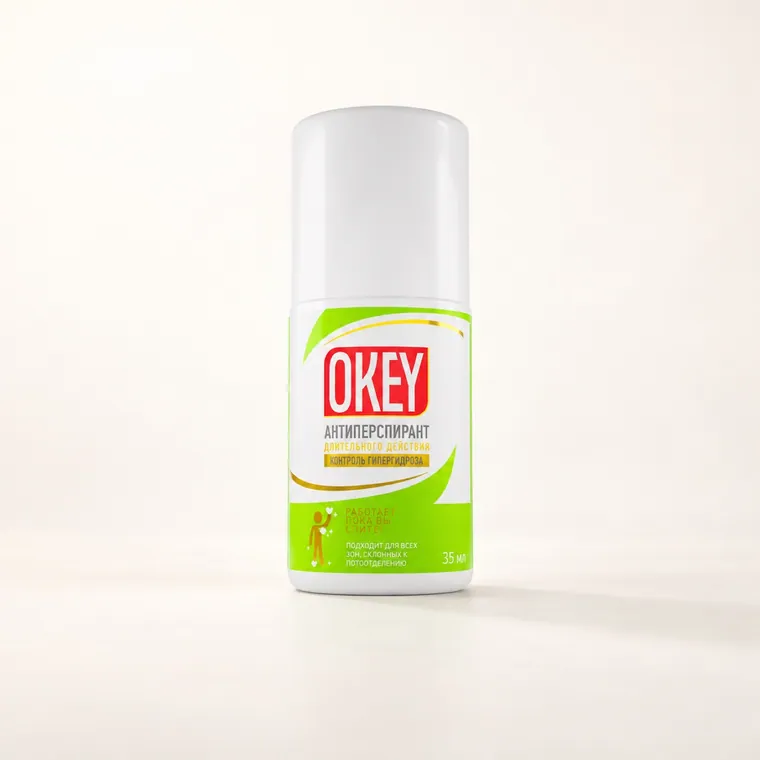
OKEY is a product of the team that owns this website. The OKEY journal advises closing the cap tightly, keeping the bottle upright and following the storage conditions stated on the pack. It is a roll-on, not an aerosol, so the rules for pressurized cans do not apply to it. Its active ingredient is aluminum chloride: it is applied in the evening, 2–3 strokes of the roller on clean, completely dry and intact skin, and washed off in the morning. The stated effect lasts up to 72 hours, then 1–2 times a week or as needed, so one bottle lasts a long time and storage matters especially. According to the instructions, the compact 35 ml bottle is easy to keep at home, in a cosmetic bag or a travel bag. It contains no alcohol or fragrance, but has six care ingredients: aloe vera, panthenol, hyaluronic acid, chamomile extract, allantoin and glycerin. OKEY suits women and men and is for the underarms, palms, feet and other areas prone to excessive sweating. It costs 7990 ₸ on Kaspi, and the bottle can be returned within 14 days.
Sources
- FDA: shelf life and expiration dating of cosmetics — heat (hot car) breaks down preservatives, sunlight, air and bathroom humidity, sharing (content current as of 25.02.2022)
- FDA: using cosmetics safely — keep containers clean and tightly closed, protect from temperature extremes, do not share, discard if colour or smell changes, aerosols (content current as of 15.10.2024)
- 21 CFR 740.11: warning for cosmetics in self-pressurized containers — do not store at temperature above 120 °F
- 21 CFR 211.137: expiration dating of drug products related to labeled storage conditions
- FDA OTC Monograph M019: warnings — keep out of reach of children, aerosols, rash or irritation
- OKEY journal: OKEY and deodorant together — close the cap tightly, keep the bottle upright, follow storage conditions on the pack
- Official OKEY instructions: application, frequency, pack format
Try OKEY
A 35 ml roll-on with aluminium chloride, free of alcohol and fragrance, for women and men. Applied in the evening, with a claimed duration of up to 72 hours. The bottle can be returned within 14 days.