Natural deodorants: what they can and can't do
People usually pick a "natural" deodorant because they want to avoid aluminum salts. Here is what the ingredient list says: what these products really do, why they don't keep the underarms dry, what causes irritation and what the word "natural" on the label means to regulators.
The short answer
A "natural" deodorant can reduce odor: it suppresses bacteria, binds smelly substances or covers them with a scent. It does not reduce sweat, because it has no aluminum salt to temporarily close the sweat-gland ducts. If odor is your only concern, such a product may be enough. If your underarms, palms or feet get wet, you need an antiperspirant. The word "natural" guarantees nothing here: neither the US nor the EU has a legal definition of it for cosmetics, and baking soda and essential oils, which are common in these formulas, can irritate the skin.
Deodorant vs antiperspirant by ingredients
Fresh sweat barely smells: odor appears when skin bacteria break down the secretions of the apocrine glands — fatty acids, proteins and steroids. That is why, as the authors of a 2023 review in the International Journal of Cosmetic Science put it, deodorant development focuses on suppressing odor-causing bacteria, while antiperspirant development focuses on reducing sweat flow. An antiperspirant works through an aluminum salt: according to the International Hyperhidrosis Society (IHHS), it forms superficial plugs in the sweat-gland ducts just below the skin surface. In the US this difference is legal too: the FDA treats a deodorant as a cosmetic, while a deodorant that is also an antiperspirant is a cosmetic and a drug, and its active ingredients are listed in monograph M019. For how to tell the two apart by INCI, see "How to tell an antiperspirant from a deodorant by its ingredients".
What "natural" on the label means
In the US, as Cedars-Sinai medical center points out, the FDA has never established a regulatory definition of "natural" for cosmetics, including deodorants. In the EU, cosmetic claims must meet the common criteria of Regulation 655/2013: legal compliance, truthfulness, evidential support, honesty, fairness and informed decision-making. The European Commission's technical document on claims covers "free from" and "hypoallergenic" wording in detail, but it contains no separate definition of "natural" cosmetics. Two practical rules follow from the same document. A "free from perfume" claim is not allowed if the product contains an ingredient with a perfuming function, even a plant oil. And "free from" claims built on fear of an authorized ingredient are considered unfair by the Commission, because every cosmetic product must be safe. So "natural" and "aluminum-free" are marketing words; the ingredient list is what you should check.
Baking soda: against odor, but not for everyone
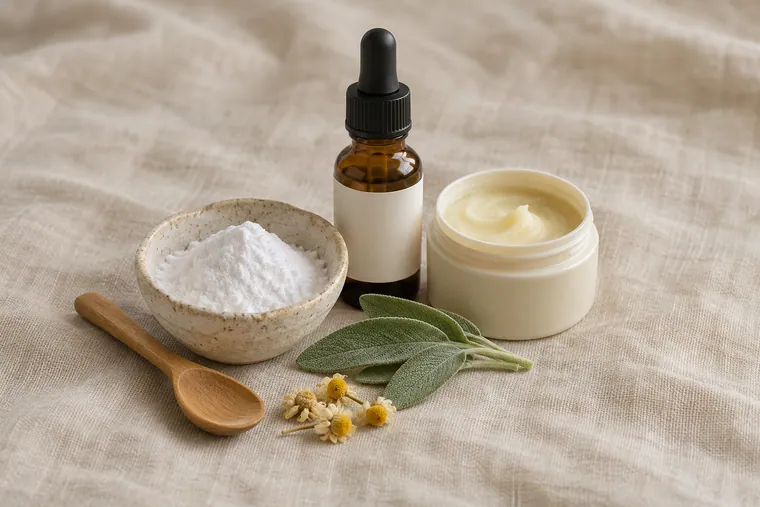
Baking soda (Sodium Bicarbonate) is one of the most common ingredients in "natural" deodorants. The 2023 review notes that it has antimicrobial activity, so it can reduce odor. But baking soda has a downside: it is an alkaline substance, used as an alkalizing and buffering agent, while healthy skin is covered by a slightly acidic "acid mantle". A review in Acta Dermato-Venereologica links skin acidity to the function of the stratum corneum, the barrier and antimicrobial defense, and advises choosing products that preserve this mantle. The American Academy of Dermatology (AAD) explicitly advises people with hidradenitis suppurativa to choose an antiperspirant or deodorant without alcohol, baking soda, parabens, dyes or fragrance, because these ingredients can irritate the skin and trigger a flare-up. If your underarms turn red, itch or darken after switching to a "natural" deodorant, first check whether the ingredient list contains Sodium Bicarbonate.
Zinc, magnesium and alcohol
Zinc ricinoleate (Zinc Ricinoleate) is the leading odor absorber in deodorants. The European cosmetic ingredient database COSMILE explains that it binds odor molecules in so-called tubular inclusion compounds, and stresses separately that odor absorbers affect neither sweat formation nor skin bacteria. Magnesium hydroxide (Magnesium Hydroxide) often replaces baking soda in "natural" formulas; the same database lists only absorbent and buffering (pH-controlling) functions for it, with no deodorant function, and it has no effect on sweating. Ethyl alcohol (Alcohol, Alcohol Denat.) serves as a solvent and, as the European Commission notes, protects the product against microorganisms; on the skin it also briefly reduces the number of bacteria. But on freshly shaved or irritated skin alcohol can sting — more in "Alcohol in antiperspirants: what it does and who it bothers".
Plant extracts and essential oils
Extracts and essential oils are added to suppress bacteria and cover odor. The authors of the 2023 review write that such ingredients may not suit people with strong body odor or patients with hyperhidrosis, and strongly encourage testing a new product on a small patch of skin. Essential oils are a plant-derived fragrance and contain the same fragrance allergens as synthetic fragrances. Since 2023 the EU has expanded the list of fragrance allergens that must be named individually in the ingredient list: for leave-on products, above 0.001%. If the label of a "natural" deodorant lists Linalool, Limonene, Citral, Geraniol or Eugenol, it contains fragrance, even if the front shows leaves. For who should avoid fragrance, see "Fragrance in antiperspirants: who it bothers".
What a "natural" deodorant can't do
It does not reduce the amount of sweat: neither baking soda, nor zinc, nor magnesium, nor extracts close the sweat-gland ducts. So it won't prevent wet patches on clothes, slippery palms or damp socks. An alum crystal, also sold as "natural" and "mineral", does contain an aluminum salt, but its effect on sweat has not been confirmed by independent clinical studies — see "Alum and 'mineral' deodorants: do they work?". If sweating is heavy, started suddenly, comes with night sweats, weight loss or fever, or does not decrease even with correct antiperspirant use, see a doctor: it may be hyperhidrosis or a sign of another condition.
OKEY: when you need an antiperspirant
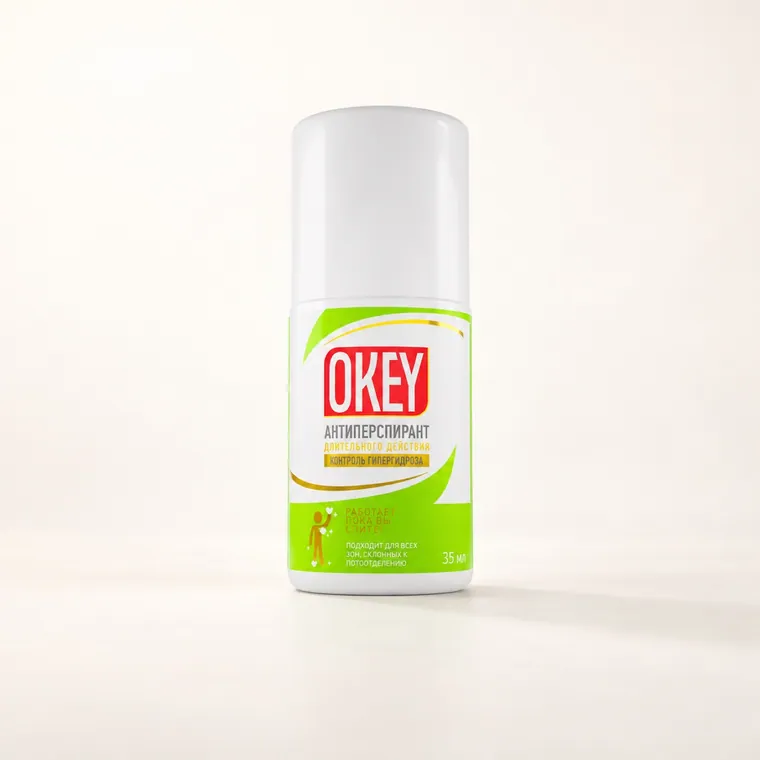
OKEY is a product of the team that owns this website. It is an antiperspirant, not a deodorant: its active ingredient is aluminum chloride in an aqueous solution, one of the actives listed in the FDA monograph, and it reduces sweating in the treated area. It contains no alcohol, fragrance or baking soda, but has six care ingredients: aloe vera, panthenol, hyaluronic acid, chamomile extract, allantoin and glycerin. OKEY is applied in the evening in a thin layer to clean, completely dry and intact skin and washed off in the morning; the stated effect lasts up to 72 hours. After hair removal or shaving, wait up to 48 hours. The 35 ml roll-on suits women and men and is for the underarms, palms, feet and other areas prone to excessive sweating. OKEY costs 7990 ₸ on Kaspi, and the bottle can be returned within 14 days.
Sources
- International Journal of Cosmetic Science (2023), Teerasumran et al.: deodorants and antiperspirants — new trends in active agents (odor formation, sodium bicarbonate, plant extracts)
- FDA: Is it a cosmetic, a drug, or both? — deodorants that are also antiperspirants
- FDA OTC Monograph M019: permitted antiperspirant active ingredients
- International Hyperhidrosis Society: antiperspirant basics — how sweat-duct plugs form
- Cedars-Sinai (2022): the truth about natural deodorant — no FDA definition of 'natural'
- European Commission: technical document on cosmetic claims (common criteria of Regulation 655/2013, 'free from' claims)
- COSMILE Europe: deodorants — odour absorbers do not affect sweat formation
- COSMILE Europe: deodorising ingredients — zinc ricinoleate as the leading odour absorber
- COSMILE Europe: Magnesium Hydroxide — absorbent and buffering functions
- PubChem: sodium bicarbonate — alkalizing and pH buffering agent
- Acta Dermato-Venereologica (2013), Ali & Yosipovitch: skin pH — from basic science to basic skin care
- American Academy of Dermatology: hidradenitis suppurativa self-care — deodorants without alcohol, baking soda or fragrance
- European Commission: fragrance allergens
Try OKEY
A 35 ml roll-on with aluminium chloride, free of alcohol and fragrance, for women and men. Applied in the evening, with a claimed duration of up to 72 hours. The bottle can be returned within 14 days.