Sensitive underarm skin: rules for choosing a product
Underarm skin lives in special conditions: a fold, friction, warmth, moisture and regular hair removal. That is why the same product can work well for one person and sting for another. We explain how to tell irritation from allergy and which rules help you choose and apply an antiperspirant without discomfort.
Why the underarms react more often
The armpit is a skin fold: the skin is constantly in contact with itself and with clothing, arm movement creates friction, and under the fabric it is warm and damp. Add shaving or hair removal, and the outer layer of the skin becomes more vulnerable. Antiperspirant is applied to exactly this area and left on for hours, so even a small application mistake — damp skin, a fresh nick, an extra layer — is felt more strongly here than elsewhere on the body.
Irritation or allergy
These are two different reactions. Irritation appears where the product was applied: burning, stinging, redness, dryness. Cleveland Clinic lists mild irritation, redness and dryness among the common side effects of aluminium chloride solutions that usually don’t need medical attention. Irritation depends on the dose, frequency and condition of the skin, so it can often be reduced with application rules. An allergy is an immune reaction to a specific substance. DermNet describes fragrance allergy as itchy, scaly red patches where contact occurred and notes that the armpits are commonly affected. A rash and itching as signs of an allergic reaction should be reported to a doctor; once the substance is identified, it is avoided.
Rule 1: only dry, intact skin
The American Academy of Dermatology (AAD) advises applying antiperspirant to dry skin before bedtime and letting it dry completely; with irritation, make sure the skin is very dry. Moisture on the skin mixes with the product and makes irritation more likely. After a shower, pat the underarms dry with a towel and wait a few minutes. The FDA monograph M019 requires not applying antiperspirant to broken skin: scratches, abrasions, scratched or inflamed areas are a reason to skip an application.
Rule 2: a pause after hair removal
Razors and epilators leave micro-damage on the skin that isn’t always visible but makes itself felt right away as stinging. So it is better to separate hair removal and antiperspirant application in time: for example, shave the underarms in the morning and apply the product after the interval stated in the instructions. Manufacturers of strong products often state a mandatory pause after shaving or hair removal — it is worth keeping even if the skin looks calm.
Rule 3: fewer extras in the formula
If your skin reacts, start with a formula without fragrance and without ethyl alcohol: fragrance is a common cause of allergy, and an alcohol base can sting on irritated skin. Check the INCI list rather than the claims on the front: “unscented” doesn’t always mean “fragrance-free”. We cover this in detail in the articles “Fragrance in antiperspirants: who it bothers” and “Alcohol in antiperspirants: what it does and who it bothers”. Remember that the active ingredient itself can also irritate the skin, so a short ingredient list doesn’t replace the rules that follow.
Rule 4: the routine matters more than strength
For irritation, the AAD advises increasing the time between applications and trying a different form, such as a gel. DermNet recommends applying the product to dry skin before sleep and, if it tends to irritate, washing it off in the morning; frequency ranges from once a week to daily. More product doesn’t mean a better result: an extra layer takes longer to dry and is in longer contact with the skin and clothing. Start with the minimum amount stated in the instructions and watch your skin for a few days.
When to stop and see a doctor
The FDA monograph requires stopping antiperspirant use if a rash or irritation occurs. Persistent redness, itching, swelling, weeping or cracks are a reason to see a dermatologist rather than trying one product after another. The AAD also advises telling a dermatologist about darkening of the underarm skin: there are ways to deal with it. If the sweating itself is heavy and gets in the way of daily life, look into the causes with a doctor — see our article “When increased sweating is a reason to see a doctor”. This material is for reference and does not replace a specialist’s advice.
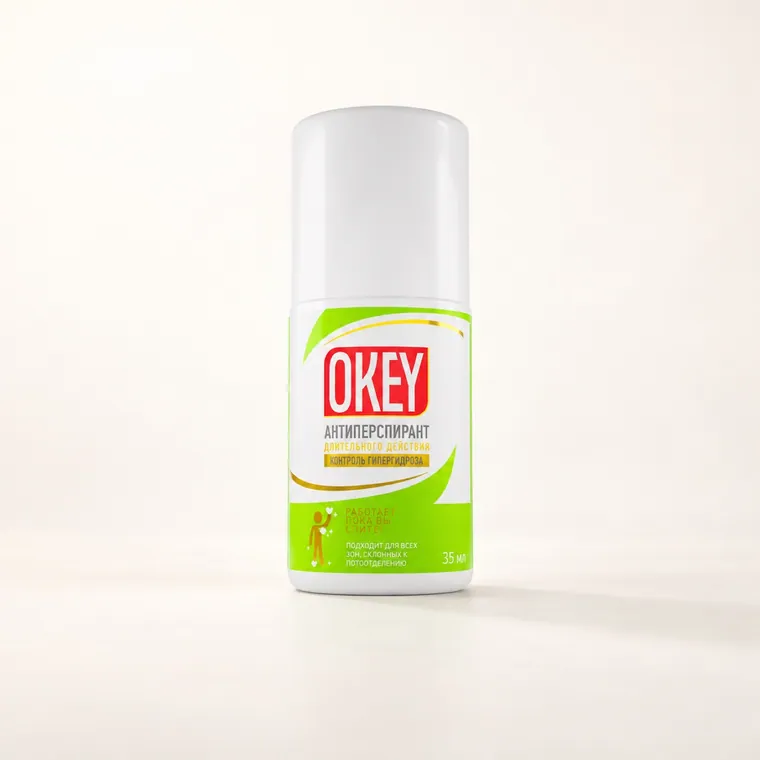
OKEY for sensitive underarm skin
OKEY is made by the team that owns this site. It is a 35 ml roll-on for women and men with aluminium chloride in a water base, without alcohol and without fragrance, with care ingredients: aloe vera, panthenol, hyaluronic acid, chamomile extract, allantoin and glycerin. Its instructions follow the rules of this article: apply in the evening to clean, completely dry, unbroken skin, leave it on overnight and wash it off in the morning, then use as needed to maintain the result; the claimed duration is up to 72 hours. After hair removal, wait up to 48 hours, and the product must not be applied to damp, irritated or broken skin. If you are allergic to chamomile, take its extract into account. You can try OKEY via the official site okeystaydry.com or the Kaspi link below; if the product doesn’t suit you, the bottle can be returned within 14 days.
Sources
Try OKEY
A 35 ml roll-on with aluminium chloride, free of alcohol and fragrance, for women and men. Applied in the evening, with a claimed duration of up to 72 hours. The bottle can be returned within 14 days.