Silicones in antiperspirant: cyclomethicone and dimethicone
Cyclopentasiloxane, Cyclomethicone, Dimethicone: these names often appear at the top of the ingredient list of sticks and sprays. Here is what silicones do in an antiperspirant, how volatile ones differ from non-volatile ones, what is known about their safety for the skin and why the European Union nevertheless restricts some of them.
The short answer
Silicones are responsible for glide, spreading and a dry feel after application, but they do not reduce sweat: the aluminum salt does that. Cyclomethicone is a mixture of cyclic silicones, and cyclopentasiloxane (D5) is one of them; they are volatile and mostly evaporate from the skin. Dimethicone is a polymer: it does not evaporate and stays as a smooth film. The CIR Expert Panel found both the cyclic silicones and dimethicone safe in cosmetics at current concentrations; the SCCS considers D5 safe in cosmetics except hair styling aerosols and sun care sprays. The EU restrictions on D4, D5 and D6 are about the environment: in rinse-off cosmetics they have applied since 2020, and for other cosmetics, including antiperspirants, they will apply after 6 June 2027.
Why antiperspirants contain silicones
The EU Scientific Committee on Consumer Safety (SCCS) lists the functions of D5 in cosmetics: antistatic, emollient, humectant, solvent, viscosity control and hair conditioning. According to the SCCS, the main uses of D5 are skin care, deodorants and antiperspirants, hair care and make-up. In an antiperspirant, a volatile silicone helps spread the aluminum salt evenly and quickly gives a dry feel, after which it largely evaporates. Dimethicone reduces stickiness and friction and makes the layer smooth. Sticks are often built on a solid silicone base; more on this in the article "How to choose an antiperspirant: roll-on, stick, spray, cream".
Cyclomethicone, D4, D5, D6: what the names mean
The CIR Expert Panel reviewed cyclomethicone, which is a mixture, together with the individual cyclic silicones with rings of 4–7 units. All of them are cyclic dimethyl polysiloxanes. In ingredient lists they appear as Cyclotetrasiloxane (D4), Cyclopentasiloxane (D5), Cyclohexasiloxane (D6), Cycloheptasiloxane and the general name Cyclomethicone, which stands for a mixture of rings. The letter D and the number are a technical notation for the number of units in the ring. The SCCS notes that D5 may contain traces of D4, and D4 is classified in the EU as toxic to reproduction, so the D4 impurity in D5 should be kept as low as possible. If the pack simply says Cyclomethicone, the name alone does not tell you which rings are in the mixture.
Dimethicone: a non-volatile silicone
Dimethicone (polydimethylsiloxane) is not a ring but a long polymer. It does not evaporate and stays on the skin as a thin smooth layer, so it is used for glide and comfort. In 2003 the CIR Expert Panel found dimethicone and related methicone polymers safe as used in cosmetic formulations; in human and animal studies dimethicone was not absorbed either orally or through the skin. In 2022 the CIR re-reviewed this group of ingredients. Dimethicone does not plug the sweat ducts the way an aluminum salt does and does not reduce sweat on its own.
What is known about safety for the skin
In 2011 the CIR concluded that cyclomethicone and the cyclic silicones with 4–7 units are safe in cosmetics in the present practices of use and concentration: percutaneous absorption is minimal, the data do not suggest irritation or sensitization, and dermal exposure from cosmetics is not likely to cause significant systemic exposure. In its 2015 opinion (final version 2016), the SCCS assessed D5 as slightly irritating to skin and eyes and not a skin sensitiser; modelling in volunteers indicated that about 0.05% of applied D5 enters the bloodstream. The final SCCS conclusion: D5 is safe in cosmetics at the reported concentrations, except hair styling aerosols and sun care sprays, where inhaled air concentrations could be too high. For spray deodorants the SCCS found no such exceedance.
Why the EU restricts D4, D5 and D6
The restrictions are about the environment, not about harm to the skin. Under EU Regulation 2018/35, D4 meets the criteria for a persistent, bioaccumulative and toxic substance and for a very persistent and very bioaccumulative one, and D5 meets the very persistent and very bioaccumulative criteria. Rinse-off cosmetics were restricted first, because silicones from them go straight into waste water: since 31 January 2020, D4 and D5 may not be used in them at 0.1% or more. Leave-on products were not affected then: the regulation notes that silicones from them evaporate over time. EU Regulation 2024/1328 extended the restriction to D4, D5 and D6 at 0.1% or more: in general it applies after 6 June 2026, and for cosmetics that are not washed off, including antiperspirants, after 6 June 2027.
How to find silicones in an ingredient list
Silicones are recognised by the endings -siloxane and -methicone: Cyclopentasiloxane, Cyclohexasiloxane, Cyclomethicone, Dimethicone, as well as Dimethiconol and other similar names. The closer to the top of the list, the more silicone there is in the formula. If you want to avoid D4, D5 and D6, look for Cyclotetrasiloxane, Cyclopentasiloxane, Cyclohexasiloxane and Cyclomethicone. For the skin, the presence of silicone is not a drawback in itself: neither the CIR nor the SCCS found irritating or allergenic potential, and choosing a product without them is more a matter of texture and of your view on the environment. If your skin still reacts to a product, stop using it and show the full ingredient list to a dermatologist.
OKEY: a gel with care ingredients
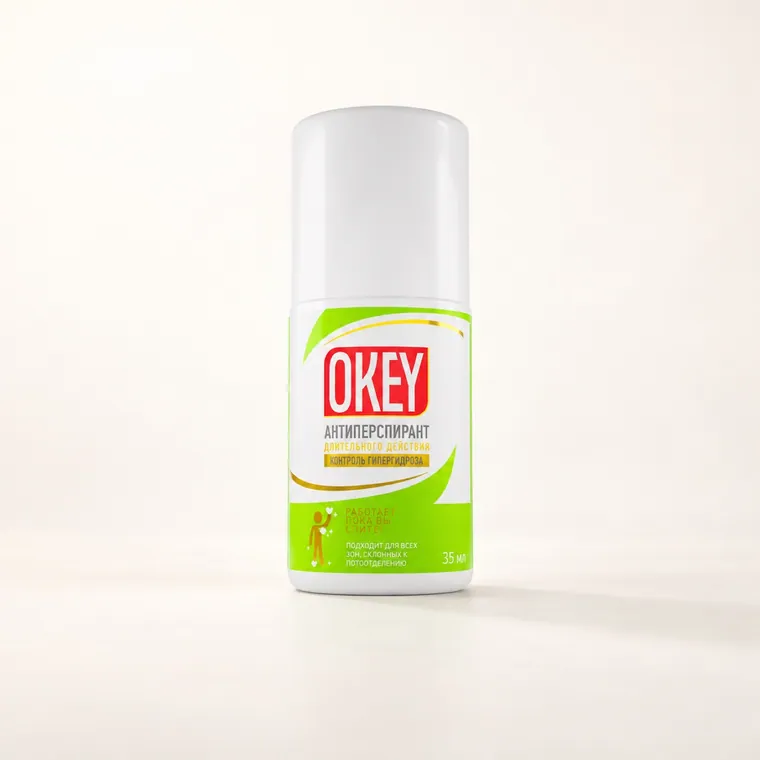
OKEY is a product of the team that owns this website. The official website okeystaydry.com states: the active ingredient is aluminum chloride, the texture is a light gel that spreads quickly in a thin layer, there is no alcohol or fragrance, and there are six care ingredients: aloe vera, panthenol, hyaluronic acid, chamomile extract, allantoin and glycerin. The full INCI list is not given on the website; it can be requested from the OKEY team through the official site. The product is applied in the evening, 2–3 strokes of the roller on clean, completely dry and intact skin, and washed off in the morning, so it does not transfer to daytime clothing. The stated effect lasts up to 72 hours, then 1–2 times a week or as needed. After hair removal or shaving, wait up to 48 hours. The 35 ml roll-on suits women and men and is for the underarms, palms, feet and other areas prone to excessive sweating. OKEY costs 7990 ₸ on Kaspi, and the bottle can be returned within 14 days.
Sources
- SCCS/1549/15: opinion on decamethylcyclopentasiloxane (D5) in cosmetic products, final version 29.07.2016
- Johnson et al., International Journal of Toxicology 30 (2011) 149S–227S: CIR safety assessment of cyclomethicone and cyclic siloxanes D4–D7
- Nair et al., International Journal of Toxicology 22 Suppl 2 (2003): CIR final report on dimethicone and methicone polymers
- Commission Regulation (EU) 2018/35: REACH restriction of D4 and D5 in wash-off cosmetics from 31.01.2020
- Commission Regulation (EU) 2024/1328: REACH Annex XVII entry 70 — D4, D5, D6 ≥ 0.1% after 06.06.2026, other cosmetics after 06.06.2027
- Official OKEY website: light gel, alcohol- and fragrance-free; full INCI on request
Try OKEY
A 35 ml roll-on with aluminium chloride, free of alcohol and fragrance, for women and men. Applied in the evening, with a claimed duration of up to 72 hours. The bottle can be returned within 14 days.