Triclosan in deodorants and antiperspirants: what has changed
For a long time triclosan was a common antibacterial ingredient in soap, toothpaste and deodorants. Then its use was restricted both in the US and in the European Union. Here is what exactly was banned, what is still allowed and whether it is worth looking for triclosan in an underarm product.
The short answer
Triclosan is an antibacterial substance. In 2016 the FDA removed it and 18 other substances from over-the-counter antibacterial soaps and body washes, because manufacturers had not shown that they are safe for daily use over many years or work better than ordinary soap and water. In the EU, triclosan is allowed as a preservative only in certain products, including non-spray deodorants, up to 0.3%. It does not reduce sweat: that is the job of the aluminum salt. A product against sweat does not need triclosan.
What triclosan is
Triclosan is a synthetic antibacterial substance. For EU cosmetics it is listed in Annex V of Regulation 1223/2009, the list of permitted preservatives. It was added to underarm products to fight the bacteria involved in odour. It is important not to confuse the two: triclosan acts on bacteria, not on the sweat glands. An antiperspirant reduces sweat with an aluminum salt that temporarily plugs the sweat ducts. A product with triclosan but no aluminum salt is a deodorant, not an antiperspirant.
What the FDA decided
On 6 September 2016 the FDA published a final rule on over-the-counter consumer antiseptic wash products. It removed 19 active ingredients, including triclosan and triclocarban, from liquid, foam and gel hand soaps, bar soaps and body washes. The reason: manufacturers had not shown that these ingredients are safe for long-term daily use or that such products are more effective than plain soap and water. The rule covers only products that are rinsed off with water; it does not apply to hand sanitizers, hand wipes or antibacterial soaps used in health care settings. Underarm products are not regulated by this rule. The FDA's advice to consumers is simple: wash your hands with plain soap and water.
What is allowed in the EU
Previously, triclosan was allowed in all cosmetics in the EU at up to 0.3%. The EU scientific committees (the SCCP in 2009 and the SCCS in a 2011 addendum) concluded that using 0.3% in all cosmetic products is not safe because of the magnitude of the aggregate exposure. They considered such use safe in toothpastes, hand soaps, body soaps and shower gels, deodorants, face powders and blemish concealers. After that, Regulation 358/2014 narrowed the permission. Today triclosan is allowed up to 0.3% only in toothpastes, hand soaps, body soaps and shower gels, non-spray deodorants, face powders and blemish concealers, and nail products for cleaning the nails before applying artificial nail systems, and up to 0.2% in mouthwashes. From 30 October 2014 only products complying with these rules may be placed on the EU market, and from 30 July 2015 others may no longer be made available.
Is triclosan needed against odour
Sweat odour does not come from sweat itself: it is produced by skin bacteria that break down the secretions of the sweat glands. So odour can be tackled in two ways: by reducing the number of bacteria, or by reducing the sweat they live in. Triclosan belongs to the first approach. An antiperspirant belongs to the second: it reduces sweat and with it the environment for bacteria. If your underarms sweat heavily, no antibacterial substance will make them dry. If sweating is moderate but odour bothers you, the NHS advises washing your armpits with soap at least twice a day, drying them well, using antiperspirants and deodorants and washing clothes often.
How to find triclosan in an ingredient list
In the ingredient list it is simply called Triclosan. The related substance Triclocarban also appears; the FDA removed it from antibacterial soap together with triclosan, but it is a different substance. If you see Triclosan in an underarm spray intended for the EU market, that contradicts the rules: there it is allowed only in deodorants that are not sprayed. Our ingredient atlas does not yet have a separate page on triclosan; for the preservatives that are more common in antiperspirants, read the article "Parabens in antiperspirant: why they are used and what is known".
When to see a doctor
If the smell of your sweat suddenly changes, the NHS advises seeing a doctor when self-care has not helped and the smell has become unusual for you, you have suddenly started sweating much more than usual, or the odour is affecting your life and self-esteem. If a rash or irritation appears after any underarm product, stop using it: this warning is in the FDA antiperspirant monograph. If the irritation does not go away, see a dermatologist.
OKEY: against sweat, not only against bacteria
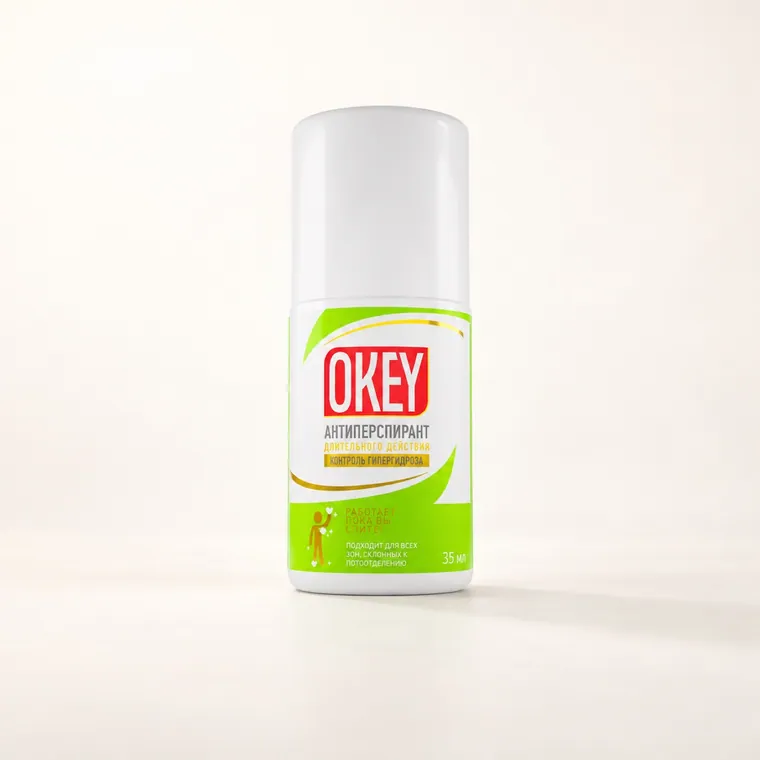
OKEY is a product of the team that owns this website. It is an antiperspirant: its active ingredient is aluminum chloride, and it works on sweat itself, not only on odour. The official website okeystaydry.com states: there is no alcohol or fragrance, and there are six care ingredients: aloe vera, panthenol, hyaluronic acid, chamomile extract, allantoin and glycerin; the full INCI list can be requested from the OKEY team through the website. The product is applied in the evening, 2–3 strokes of the roller on clean, completely dry and intact skin, and washed off in the morning; the stated effect lasts up to 72 hours, then 1–2 times a week or as needed. After hair removal or shaving, wait up to 48 hours. The 35 ml roll-on suits women and men and is for the underarms, palms, feet and other areas prone to excessive sweating. OKEY costs 7990 ₸ on Kaspi, and the bottle can be returned within 14 days.
Sources
- FDA: Consumer antiseptic wash final rule Q&A — 19 ingredients incl. triclosan, published 06.09.2016
- FDA: skip antibacterial soap, use plain soap and water — scope of the rule (content current as of 12.12.2024)
- Commission Regulation (EU) No 358/2014: triclosan — SCCP/SCCS opinions, Annex V entry 25 (0.3%, non-spray deodorants; 0.2% mouthwash), dates
- FDA: Is it a cosmetic, a drug, or both? — deodorants vs antiperspirants
- International Journal of Cosmetic Science (2023), Teerasumran et al.: odor formation by skin bacteria
- NHS: body odour — self-care and when to see a GP
- FDA OTC Monograph M019: warnings — rash or irritation
Try OKEY
A 35 ml roll-on with aluminium chloride, free of alcohol and fragrance, for women and men. Applied in the evening, with a claimed duration of up to 72 hours. The bottle can be returned within 14 days.