Alcohol in antiperspirants: what it does and who it bothers
The word alcohol in an antiperspirant’s ingredient list can mean very different substances: volatile ethyl alcohol, softening fatty alcohols or the preservative benzyl alcohol. We explain why they are added, who ethanol bothers and how to read the label to know what is actually in the bottle.
Which alcohol is meant
According to the FDA, the word alcohol on a cosmetic label, without qualification, means ethyl alcohol; in INCI it appears as Alcohol, Alcohol Denat. or Ethanol. An “alcohol-free” claim refers to exactly that. But such a product can still contain other substances with alcohol in their name, and their effect on the skin is quite different. So before deciding whether alcohol bothers you, it helps to know which alcohol is on the label.
Why antiperspirants contain ethanol
Ethyl alcohol is a volatile solvent. It dissolves the formula’s ingredients and evaporates quickly, so the product feels fast-drying and fresh. It is used in gels, sprays and liquid solutions, including some aluminium chloride solutions. The flip side of that volatility is dryness: the FDA notes that many people choose alcohol-free products because they believe ethyl alcohol dries the skin. On freshly shaved, irritated or not fully dry skin, an alcohol base can sting.
Fatty alcohols are a different matter
Cetyl Alcohol, Stearyl Alcohol and Cetearyl Alcohol are waxy substances. The FDA explicitly calls them fatty alcohols and stresses that their effects on the skin are quite different from those of ethyl alcohol; they may appear even in products labelled “alcohol free”. In antiperspirants, fatty alcohols thicken the base — especially in sticks and creams — and soften the skin. They are not volatile and don’t evaporate from the skin the way ethanol does, so the word alcohol in their name is no reason on its own to avoid a product.
Benzyl alcohol
Benzyl Alcohol is an aromatic alcohol. In cosmetics it is used as a preservative and solvent, and it is also a component of fragrances. The European Commission includes benzyl alcohol in the list of fragrance allergens that must be named on the label when their content exceeds a set threshold. It isn’t ethyl alcohol, but people who are allergic to fragrance components should look out for it in the ingredient list.
Who alcohol bothers
Ethanol matters most if you have sensitive skin, after shaving or hair removal, and if an alcohol-based product has stung before. This is especially true of strong formulas: aluminium chloride can irritate the skin on its own, and an alcohol base can add to the discomfort. For antiperspirant irritation, the AAD advises applying the product less often, trying a different form such as a gel, and applying it only to very dry skin. The FDA monograph requires not applying an antiperspirant to broken skin and stopping use if a rash or irritation occurs. That said, being alcohol-free doesn’t cancel the irritation potential of the active itself: the application rules matter for any formula.
How to read the INCI list
Ingredients are listed in descending order of concentration; those present at less than 1% may be listed in any order. Alcohol, Alcohol Denat., SD Alcohol or Ethanol is ethyl alcohol; if it comes near the top of the list, the product has an alcohol base. Cetyl, Stearyl and Cetearyl Alcohol are fatty alcohols that thicken and soften. Benzyl Alcohol is a preservative or a fragrance component. Glycerin, Propylene Glycol and Phenoxyethanol are not ethyl alcohol. Check the ingredients on the pack of your own batch: formulas change. We cover reading the whole list in the article “How to read an antiperspirant ingredient list”.
OKEY: a strong active without alcohol
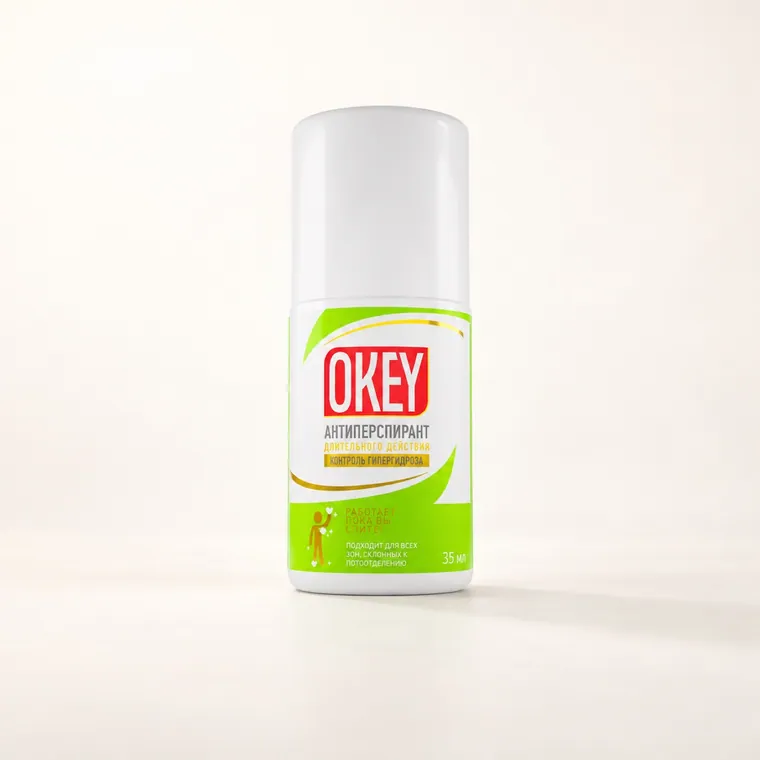
OKEY is made by the team that owns this site. It is a 35 ml roll-on for women and men with aluminium chloride in a water base; according to its published ingredients it contains neither ethyl alcohol nor fragrance. Its INCI: Aqua, Aluminum Chloride, Glycerin, Panthenol, Propylene Glycol, Chamomilla Recutita Flower Extract, Aloe Barbadensis Leaf Gel, Allantoin, Hyaluronic Acid, Hydroxyethylcellulose, Sodium Hydroxide, Phenoxyethanol, Ethylhexylglycerin. Water comes first, and there is no Alcohol, Alcohol Denat. or Ethanol on the list. The care ingredients are aloe vera, panthenol, hyaluronic acid, chamomile extract, allantoin and glycerin. OKEY is applied in the evening to clean, completely dry, unbroken skin and washed off in the morning; the claimed duration is up to 72 hours. After hair removal, wait up to 48 hours, and even without alcohol the product must not be applied to damp, irritated or broken skin. You can try OKEY via the official site okeystaydry.com or the Kaspi link below; the bottle can be returned within 14 days.
Sources
Try OKEY
A 35 ml roll-on with aluminium chloride, free of alcohol and fragrance, for women and men. Applied in the evening, with a claimed duration of up to 72 hours. The bottle can be returned within 14 days.