Alum and "mineral" deodorants: do they work?
Alum crystals are sold as a "natural" and "mineral" replacement for antiperspirant, often labelled "aluminum-free". Here is what the ingredient list says: what this salt is, what it really helps with, what is known about its effect on sweat and when a crystal is not enough.
The short answer
Alum is an aluminum salt. It can work against odor: in laboratory experiments alum suppresses the bacteria that make sweat smell. But we found no independent clinical studies confirming how much a crystal reduces sweat itself, and in the US potassium alum is not on the list of permitted active ingredients for over-the-counter antiperspirants. If your goal is less odor, the crystal works as a deodorant. If your underarms, palms or feet get wet, you need an antiperspirant with an aluminum salt whose effect on sweat has been confirmed.
What alum is
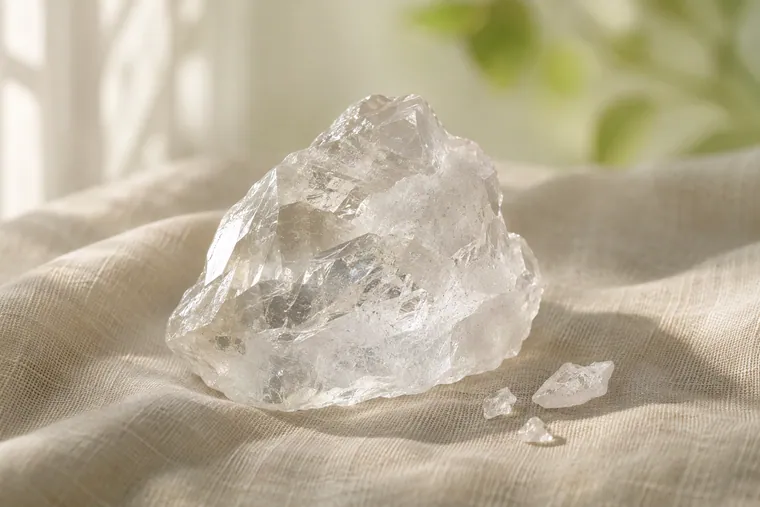
On ingredient lists alum appears as Potassium Alum (potassium aluminum sulfate, formula KAl(SO4)2·12H2O) or Ammonium Alum (aluminum ammonium sulfate). These are colorless, odorless crystals that dissolve easily in water. A "mineral deodorant" is usually a piece of such a crystal: you wet it and glide it over the skin, leaving a thin layer of salt. There are also sprays and roll-ons with an alum solution. In the EU ammonium alum is also approved as the food additive E 523; "mineral" and "natural" describe where the substance comes from, not the absence of aluminum.
Why "aluminum-free" is inaccurate
Aluminum is part of the alum formula itself; the chemical name "potassium aluminum sulfate" already shows it. An "aluminum-free" or "no aluminum salts" label on a crystal usually means something else: the product contains no aluminum chlorohydrate, aluminum chloride or aluminum zirconium salts, the actives used in ordinary antiperspirants. So read the INCI, not the slogan on the pack: if the list includes Potassium Alum or Ammonium Alum, the product contains aluminum. The EU Scientific Committee on Consumer Safety (SCCS) assessed aluminum compounds in cosmetics together, and among the described cases of skin irritation it mentions irritant dermatitis after a crystal deodorant containing alum.
Against odor: what the research shows
Fresh sweat barely smells: odor appears when skin bacteria break down secretions from the apocrine glands. In a 2016 laboratory study published in the Journal of Clinical and Health Sciences, alum suppressed the growth of four bacterial species linked to underarm and foot odor, including Staphylococcus epidermidis and Corynebacterium xerosis; at 7.5 mg/ml all four were completely inhibited. That is how a deodorant works: fewer bacteria, less odor. But the experiment was done in test tubes, not on human skin, and the authors themselves write that the safety, allergenicity and efficacy of alum on human skin still need to be studied.
Against sweat: what is known
An antiperspirant reduces sweat in a different way. As the International Hyperhidrosis Society (IHHS) describes it, sweat dissolves the aluminum salt and draws it into the sweat ducts, where shallow plugs form, and sweating in that area stops. The European cosmetic ingredient database COSMILE lists, for potassium and ammonium alum, the function "reduces perspiration" in addition to the astringent one. But an ingredient's list of functions is not an efficacy test of a particular crystal. The US rules are stricter: FDA monograph M019 lists 18 active ingredients that may be used in an over-the-counter antiperspirant: aluminum chloride, aluminum chlorohydrate and related salts, and aluminum zirconium salts. Alum is not on that list, so a product with alum as its active does not conform to this monograph. We found no independent clinical studies measuring how much an alum crystal reduces sweating.
When a crystal is not enough
If your sweating is ordinary and odor is the main problem, any product with a deodorizing effect does the job, and alum is one option. But if your clothes get wet, your palms slip or your socks soak through, odor is secondary: you need to reduce the sweating itself, and that takes an aluminum salt from the list of antiperspirant actives. Think about your skin as well: the crystal is applied wet, and on freshly shaved or irritated skin the salt can sting; if burning or redness appears, wash it off. If sweating is heavy, appeared suddenly or does not decrease with correct antiperspirant use, that is a reason to see a doctor; more in the article "When increased sweating is a reason to see a doctor".
How to check the label
Find the full ingredient list (INCI). If it includes Potassium Alum or Ammonium Alum, the product contains an aluminum salt, even when the front says "aluminum-free". Then check whether it contains aluminum chloride, aluminum chlorohydrate or an aluminum zirconium salt: these are what make a product an antiperspirant in the usual sense. The words "mineral", "natural" and "crystal" describe the origin of the raw material, not how strongly it works. Check what exactly the pack promises: freshness and odor protection, or reduced sweating. More on telling them apart is in the article "How to tell an antiperspirant from a deodorant by its ingredients".
OKEY: the active is named plainly
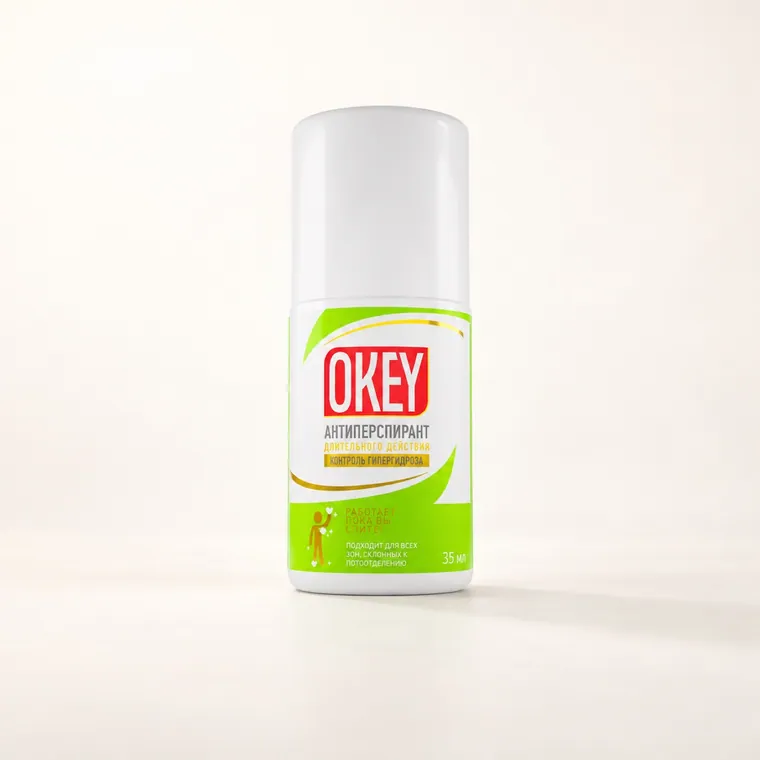
OKEY is made by the team that owns this site. We do not hide aluminum behind words like "mineral" or "natural": the OKEY active is stated plainly as aluminum chloride in an aqueous solution, one of the actives listed in the FDA antiperspirant monograph. It contains no alcohol or fragrance, but it does contain six care ingredients: aloe vera, panthenol, hyaluronic acid, chamomile extract, allantoin and glycerin. OKEY is applied in the evening in a thin layer to clean, completely dry, intact skin, washed off in the morning and then used as needed, usually once or twice a week; the stated duration is up to 72 hours. The 35 ml roll-on suits women and men and works for the underarms, palms, feet and other areas prone to excessive sweating. OKEY is available on Kaspi for 7990 ₸ with a 14-day bottle return; regular customers can order it on okeystaydry.com for 6990 ₸ with free delivery to a Flip pickup point, without a return option.
Sources
- FDA OTC Monograph M019: § M019.10 — the 18 permitted antiperspirant active ingredients (alum not listed)
- COSMILE Europe: Potassium Alum — listed cosmetic functions
- COSMILE Europe: Ammonium Alum — functions, food additive E 523
- Journal of Clinical and Health Sciences (2016): potassium aluminium sulphate (alum) inhibits growth of axillary malodour-producing skin flora in vitro
- International Hyperhidrosis Society: antiperspirant basics — how sweat-duct plugs form
- SCCS/1613/19 full text: aluminium compounds in cosmetics, irritant dermatitis after an alum crystal deodorant
Try OKEY
A 35 ml roll-on with aluminium chloride, free of alcohol and fragrance, for women and men. Applied in the evening, with a claimed duration of up to 72 hours. The bottle can be returned within 14 days.