Aluminium zirconium in antiperspirants: how it works
Aluminum Zirconium Tetrachlorohydrex GLY is one of the longest names on an antiperspirant label. It stands for a separate class of active salts with their own rules: a concentration limit, a ban in aerosols and typical product forms. We explain how these salts work and how they differ from other actives.
What these substances are
Aluminium zirconium salts are complex compounds in which aluminium and zirconium are bound to chloride and hydroxide groups. In an INCI list they are easy to spot by the words Aluminum Zirconium at the start: for example, Aluminum Zirconium Tetrachlorohydrex GLY, Trichlorohydrex GLY, Octachlorohydrex GLY or Pentachlorohydrex GLY. The prefixes tetra-, tri-, octa- and penta- reflect the ratio of aluminium, zirconium and chlorine in the complex, and GLY means the complex includes glycine. The US FDA monograph M019 includes these salts among the permitted active ingredients of over-the-counter antiperspirants.
How they reduce sweating
The principle is the same for all aluminium actives. The AAD puts it this way: an antiperspirant temporarily blocks your sweat glands, which reduces the amount of sweat you see. The salt dissolves in the moisture on the skin surface and forms plugs in the ducts of the sweat glands that stop sweat from reaching the surface. The effect is temporary, so the product is applied again. Importantly, it only works where it is applied: an antiperspirant does not affect sweating on other parts of the body.
Concentration limits in the US and the EU
The FDA monograph allows aluminium zirconium salts at up to 20% on an anhydrous basis, excluding glycine, and only in non-aerosol forms. In the EU these complexes are listed in Annex III of Cosmetics Regulation No 1223/2009: no more than 20% as the anhydrous complex and no more than 5.4% as zirconium. The regulation also defines the chemistry of the complex — a ratio of aluminium to zirconium atoms between 2 and 10, and of aluminium plus zirconium to chlorine between 0.9 and 2.1 — prohibits use in aerosol dispensers and requires a warning not to apply the product to irritated or damaged skin.
Why there are no zirconium aerosols
In the US, cosmetic aerosols containing zirconium are prohibited by rule 21 CFR 700.16. In its rationale, the FDA states that zirconium compounds have caused skin granulomas in humans and toxic effects in the lungs and other organs of laboratory animals; when sprayed, particles can reach the airways. That is why aluminium zirconium salts are found in sticks, gels, creams and roll-ons, while aerosol antiperspirants use other salts, usually aluminium chlorohydrate. If you see Aluminum Zirconium on a spray can’s ingredient list, it is a reason to double-check what you are looking at.
How it differs from aluminium chloride
Aluminium chloride is a simple salt. The FDA monograph allows it only in an aqueous non-aerosol solution, and in that form it is usually applied in the evening to dry skin. Cleveland Clinic describes aluminium chloride solutions this way: they are applied to dry skin, usually at bedtime, and mild irritation, redness and dryness are among the common side effects. Aluminium zirconium salts are typically found in everyday solid and gel products. The name of the active helps you understand the type of formula, but the individual result also depends on the base and the application routine. More on the difference between the simple salts is in the article “Aluminum chloride and aluminum chlorohydrate are not the same”.
Rules for any aluminium active
The AAD advises applying antiperspirant to dry skin before bedtime and letting it dry completely; with irritation, apply it less often, try a different form such as a gel, and make sure the skin is very dry. The FDA monograph requires not applying the product to broken skin and stopping use if a rash or irritation occurs. On the safety of aluminium, the AAD writes that research has not found a link with Alzheimer’s disease, and according to the American Cancer Society, which the AAD cites, there is no clear link between antiperspirants containing aluminium and breast cancer.
OKEY: a different active and a different routine
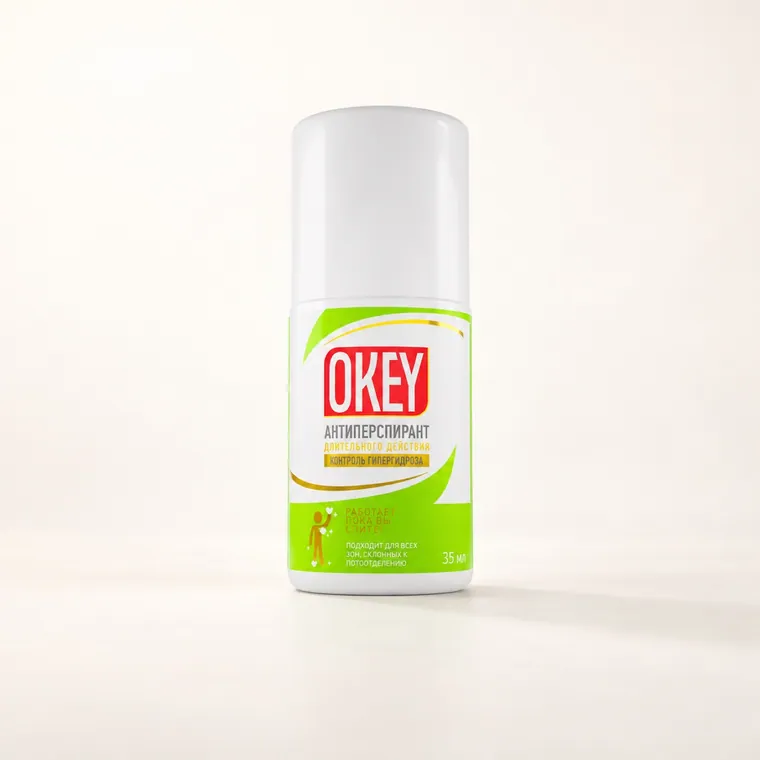
OKEY is made by the team that owns this site. It contains no aluminium zirconium salts: OKEY’s active is aluminium chloride in a water solution — the aqueous non-aerosol form the FDA monograph provides for this active. It is a 35 ml roll-on for women and men, without alcohol and without fragrance, with care ingredients: aloe vera, panthenol, hyaluronic acid, chamomile extract, allantoin and glycerin. OKEY is applied in the evening to clean, completely dry, unbroken skin, left on overnight and washed off in the morning; the claimed duration is up to 72 hours, so there is no need to reapply during the day. After hair removal, wait up to 48 hours. You can try OKEY via the official site okeystaydry.com or the Kaspi link below; if the product doesn’t suit you, the bottle can be returned within 14 days.
Sources
- FDA OTC Monograph M019: aluminum zirconium actives, limits and dosage forms
- EU Cosmetics Regulation (EC) No 1223/2009, Annex III
- 21 CFR 700.16: aerosol cosmetic products containing zirconium
- American Academy of Dermatology: hyperhidrosis treatment
- Cleveland Clinic: aluminum chloride topical solution
Try OKEY
A 35 ml roll-on with aluminium chloride, free of alcohol and fragrance, for women and men. Applied in the evening, with a claimed duration of up to 72 hours. The bottle can be returned within 14 days.