Antiperspirant for sport: how to choose it and when to apply
Antiperspirants labelled "Sport", "Active" and "Workout" sit on their own shelf, so it seems that training needs a special product. Here is what antiperspirants are actually tested for, what to look for in the ingredient list and why, for sport, the time you apply matters more than the label.
The short answer
Three things matter for training: an aluminum salt in the formula, application to completely dry skin and the right timing. The best time to apply antiperspirant is in the evening before bed, so it is already working by a morning or afternoon workout. Applying it to hot, sweaty skin just before a session does little and can cause irritation. The word "Sport" on the pack does not mean a particular level of protection: the FDA rules for antiperspirants contain no such claim. After training, the most important things are a quick shower and dry clothes.
What "Sport" on the label means
In the United States, antiperspirants are regulated by FDA monograph M019, which lists what a pack may say. Any product may state that it reduces underarm sweat. "24 hour protection" is allowed if the product reduces sweat by at least 20% over a day in testing, and "extra effective" if the reduction is 30%. There is no separate "sport" claim in the monograph. Under the FDA guideline, effectiveness is tested in a so-called hotroom: at 100 °F ± 2° (about 38 °C) and 30–40% relative humidity, after a 40-minute warm-up, with the person at rest. The guideline does not require testing during exercise. So "Sport" is the name of a product line, and products are better compared by their ingredients and by claims that are backed by testing.
What to look for in the ingredients
What separates an antiperspirant from a deodorant is an aluminum salt: Aluminum Chlorohydrate, Aluminum Zirconium Tetrachlorohydrex GLY, Aluminum Sesquichlorohydrate, Aluminum Chloride and others. According to the International Hyperhidrosis Society (IHHS), such a salt forms plugs in the sweat-gland ducts just below the skin surface. If the formula contains no aluminum salt at all, it is a deodorant: it may deal with odor, but it will not reduce sweat during a workout. The IHHS also notes that "clinical" formulas usually contain up to 20% active ingredients compared with about 10% in regular ones. For sport, look at the other ingredients too: fragrance and alcohol can sting chafed or freshly shaved skin. See "Types of aluminium salts in antiperspirants: a table", "Fragrance in antiperspirants: who it bothers" and "Alcohol in antiperspirants: what it does and who it bothers".
When to apply before a workout
The IHHS advises applying antiperspirant twice a day, in the morning and before bed, and stresses that if you apply it only once, it should be before bed. The American Academy of Dermatology (AAD) also advises applying it to dry skin at bedtime. At night the sweat glands are almost inactive, so the active ingredient reaches the ducts more easily. That is why evening application is the basis of protection for the next day's workout, especially a morning one. If you want to add a morning layer, apply it to completely dry skin: the IHHS suggests drying the skin with a towel or a hair dryer on a cool setting if needed. Applying it in the changing room once you are already sweating from the warm-up does little: on damp skin the salt works less well and irritates more often.
Which form is more convenient
The form matters less than the active ingredient: it is the aluminum salt that works, not the roll-on or the can. For sport, the most convenient form is the one you can apply in a thin, even layer and that leaves no marks on dark kit. Aerosols carry a separate warning in the FDA monograph: keep away from the face to avoid breathing it in. We will not go into forms in detail here: the difference between a roll-on and a spray is covered in "Spray or roll-on: which works better", and marks on clothing in "White and yellow marks on clothes: which forms leave fewer".
After the workout: skin and clothing
During exercise, sweat is needed for cooling. Antiperspirant only acts where it is applied, while eccrine sweat glands, according to DermNet, are spread over the whole body, so cooling continues. A wet underarm, however, rubs against your kit. Cleveland Clinic specialists call a sweaty underarm a perfect environment for chafing, advise reducing sweat with antiperspirant and changing into dry clothes as soon as possible. DermNet lists intense exercise and synthetic clothing worn close to the skin among the risk factors for prickly heat, and also advises removing wet clothing promptly. If the skin is chafed, wash it gently, pat it dry rather than rubbing, and protect it with petroleum jelly or an unscented moisturizer. Antiperspirant is not applied to damaged skin: the FDA monograph carries the warnings "do not use on broken skin" and "stop use if rash or irritation occurs".
When to see a doctor
DermNet lists exercise and heat as common sweating triggers, so heavy sweating during training is not a disease in itself. But the AAD stresses that over-the-counter antiperspirants work only for mild hyperhidrosis. See a doctor if sweat gets in the way of training even with correct evening application, if you also sweat heavily at rest, at night or all over your body, or if your sweating has suddenly increased for no clear reason. See also "When increased sweating is a reason to see a doctor".
OKEY: protection you apply the evening before
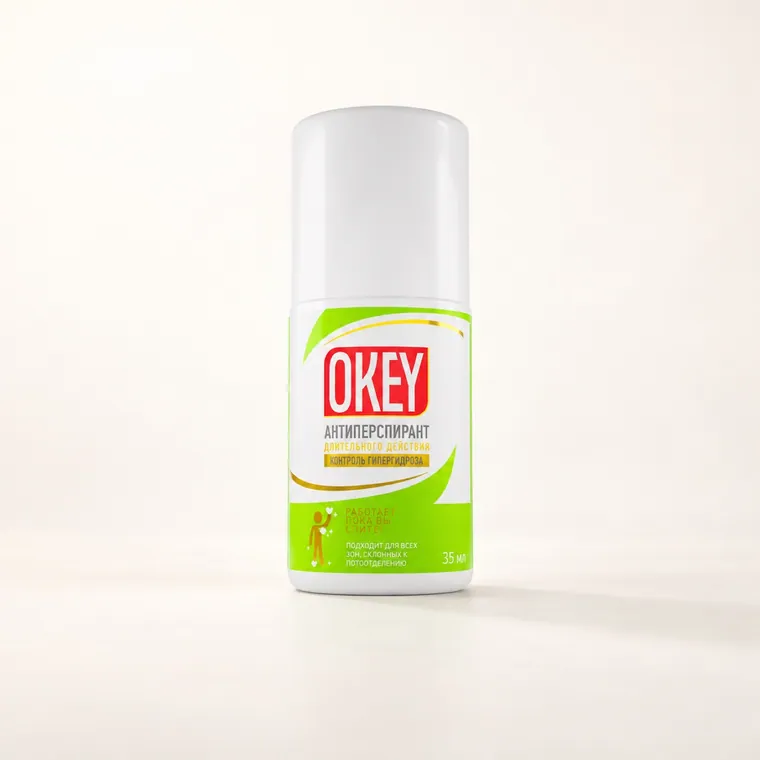
OKEY is a product of the team that owns this website. Its active ingredient is aluminum chloride in an aqueous solution, and it works as described above: the evening before, 2–3 strokes of the roller on clean, completely dry and intact skin, washed off in the morning. By the time you train it is already working, and there is no need to apply anything to sweaty skin in the changing room. The stated effect lasts up to 72 hours, then 1–2 times a week or as needed. After hair removal or shaving, wait up to 48 hours. It contains no alcohol or fragrance, but has six care ingredients: aloe vera, panthenol, hyaluronic acid, chamomile extract, allantoin and glycerin. The 35 ml roll-on suits women and men and is for the underarms, palms, feet and other areas prone to excessive sweating. OKEY costs 7990 ₸ on Kaspi, and the bottle can be returned within 14 days.
Sources
- FDA OTC Monograph M019: permitted claims (20% reduction for 24-hour protection, 30% for "extra effective"), warnings and directions
- FDA: Guidelines for effectiveness testing of OTC antiperspirant drug products — hotroom at 100 °F ± 2°, relative humidity 30–40%, 40-minute warm-up
- International Hyperhidrosis Society: tips for best results with OTC antiperspirants — completely dry skin, bedtime application
- International Hyperhidrosis Society: antiperspirant basics — sweat-duct plugs, clinical-strength products
- American Academy of Dermatology: hyperhidrosis treatment — bedtime application, OTC products for mild hyperhidrosis
- DermNet: hyperhidrosis — eccrine glands over the whole body, triggers (hot weather, exercise), antiperspirant on dry skin before sleep
- DermNet: miliaria (prickly heat) — intense exercise, occlusive synthetic clothing, removing wet clothing
- Cleveland Clinic (2025): how to prevent chafing — antiperspirant, changing into dry clothes, care for chafed skin
Try OKEY
A 35 ml roll-on with aluminium chloride, free of alcohol and fragrance, for women and men. Applied in the evening, with a claimed duration of up to 72 hours. The bottle can be returned within 14 days.