What “Clinical”, “Maximum” and “72 hours” mean on antiperspirants
Big words on the pack — “Clinical”, “Maximum”, “48 hours”, “72 hours” — promise strength and a long effect. In the US, some similar phrases really are tied to tests, but many have no single definition. We explain what stands behind each label and what to check on the pack instead.
Why some words are regulated and others are not
In the US an antiperspirant is an over-the-counter drug, and its labelling is set by FDA monograph M019 — formerly part 350 of title 21 of the Code of Federal Regulations (21 CFR 350). The monograph lists the permitted active ingredients with their maximum concentrations and the phrases that may appear under “Uses”. In the EU antiperspirants are cosmetics, and cosmetic claims are governed by Regulation No 655/2013 with common criteria: legal compliance, truthfulness, evidential support, honesty, fairness and informed decision-making. None of these documents defines the words “Clinical” or “Maximum”.
What the FDA monograph allows on the label
Only one phrase is mandatory: the product reduces underarm wetness, or a close variant of that wording. The monograph ties every other statement to test results. If a product shows standard effectiveness — a 20% sweat reduction over 24 hours — the label may say “all day protection”, “lasts all day”, “lasts 24 hours” or “24 hour protection”. If sweat reduction reaches 30%, “extra effective” is allowed, and 30% sustained over 24 hours permits combinations such as “24 hour extra effective protection”. The FDA describes the test method in separate guidelines for antiperspirant effectiveness testing.
“Clinical” and “Clinical strength”
The word “clinical” does not appear in the monograph’s list of phrases. On a pack it is usually part of a product line name, not a category assigned by a regulator. DermNet mentions “clinical strength” as an informal term for stronger over-the-counter products, but there is no single concentration or effectiveness threshold behind it. The label does not mean the product is prescription-only: in the US it remains an over-the-counter antiperspirant with the same maximum concentrations. To understand what you are looking at, check the active and its percentage in the Drug Facts panel, the phrases under “Uses”, such as “extra effective”, and the directions.
“Maximum”, “Max” and “Extra”
“Maximum” on a pack does not say maximum of what. The FDA monograph sets upper concentration limits: aluminium chloride up to 15%, calculated on the hexahydrate, and only in an aqueous non-aerosol solution; aluminium chlorohydrate and related salts up to 25%; aluminium zirconium salts up to 20% and only in non-aerosol forms. The word “Maximum” on its own does not show that a product has reached that limit, while “extra effective” is a regulated phrase only when backed by the 30% test. A higher concentration does not guarantee better tolerance either: for irritation, the AAD advises applying less often, trying a different formulation such as a gel, and making sure the skin is very dry.
“48 hours” and “72 hours”
For duration, the FDA monograph lists only wording tied to 24 hours. Figures such as 48, 72 or 96 hours are manufacturer claims and are best read together with their conditions. First, what was measured: sweat reduction, or freshness and absence of odour — for deodorants, “48 hours” usually refers to odour. Second, under what routine: the long effect of aluminium chloride products is usually linked to overnight application. The AAD describes the routine like this: the antiperspirant is applied to dry skin at bedtime until sweating is under control — usually within a few weeks — and then continued once or twice a week as needed. So “72 hours” is not a promise for every person but a guide when the directions are followed.
How to check a label in a minute
Find the active ingredient: aluminium chloride, aluminium chlorohydrate or an aluminium zirconium salt. In a US Drug Facts panel its percentage is shown next to it; a European INCI list gives no percentage, but ingredients above 1% are listed in descending order. Then read the directions: when to apply, whether to wash off, how often to repeat. Check the warnings — the FDA monograph requires “Do not use on broken skin” and “Stop use if rash or irritation occurs”. Only then look at the big words on the front: they replace neither the formula nor the routine.
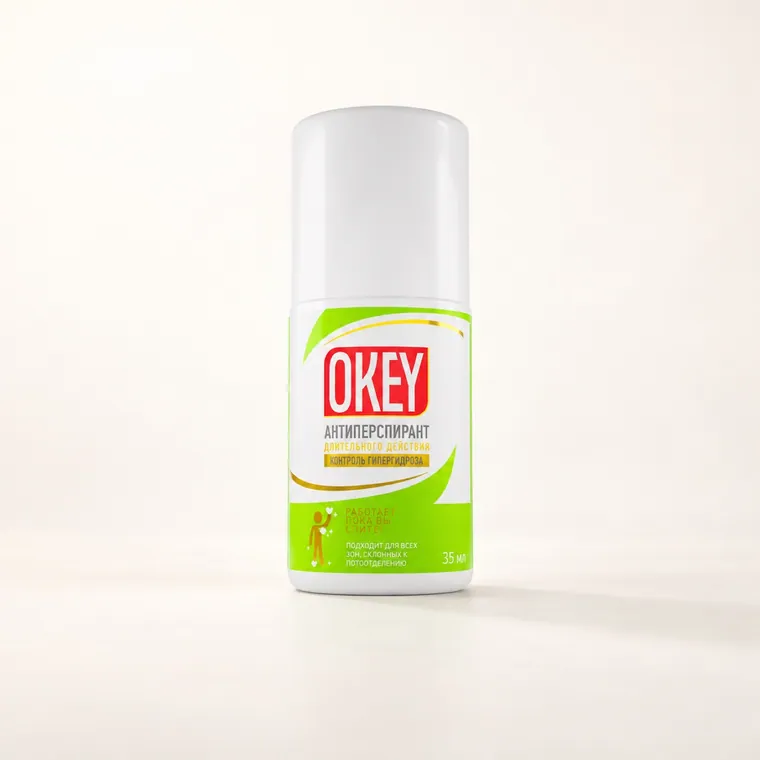
OKEY: “up to 72 hours” with a clear routine
OKEY is made by the team that owns this site. Its claimed duration is up to 72 hours, and that figure is tied to specific directions: the roll-on is applied in the evening to clean, completely dry, unbroken skin, left on overnight, washed off in the morning and then used as needed to maintain the result. The active is aluminium chloride in a water solution — the aqueous non-aerosol form the FDA monograph provides for this active. The 35 ml bottle is for women and men; it contains no alcohol and no fragrance but has six care ingredients: aloe vera, panthenol, hyaluronic acid, chamomile extract, allantoin and glycerin. After hair removal, wait up to 48 hours. You can try OKEY via the official site okeystaydry.com or the Kaspi link below; if the product doesn’t suit you, the bottle can be returned within 14 days.
Sources
Try OKEY
A 35 ml roll-on with aluminium chloride, free of alcohol and fragrance, for women and men. Applied in the evening, with a claimed duration of up to 72 hours. The bottle can be returned within 14 days.