Does skin get used to antiperspirant?
"It used to work, now it doesn't — my body must have got used to it." You often hear this when an antiperspirant suddenly seems weaker. Here is how an aluminum salt really works, whether there is any evidence of tolerance and what is behind the feeling that a product has "worn out".
The short answer
Tolerance to antiperspirant is not described in the guidance of the American Academy of Dermatology (AAD), the International Hyperhidrosis Society (IHHS) or scientific reviews on treating sweating, and its mechanism of action does not suggest it. An aluminum salt does not work like a drug the body becomes resistant to; it works mechanically, by forming plugs in the sweat-gland ducts. These plugs gradually wear off as the skin renews itself, so the effect is always temporary. When a product seems to have "stopped working", something else has usually changed: how it is applied, the formula, the weather, physical activity, stress or the sweating itself.
How an antiperspirant works
According to the IHHS, an aluminum salt forms superficial plugs just below the skin surface, and sweat stops coming out of these ducts. The plugs stay in place for at least 24 hours and are then gradually washed away. The IHHS page for healthcare professionals on aluminum chloride adds that normal sweat-gland function returns with epidermal renewal, so application has to be repeated once or twice a week. In a study on the palms, the effect appeared 48 hours after treatment began, and sweating increased again 48 hours after it stopped. That is a temporary effect, not "tolerance": if you stop applying the product or apply it less often, sweat returns because the plugs are gone, not because the skin has "learned" to get around them.
What is known about tolerance
The sources we reviewed contain no data showing that sweat glands stop responding to aluminum salts over time. On the contrary, a 2016 review in Dermatology and Therapy describes long-term follow-up in which satisfaction with maintenance treatment rose to 87%, and in one case series most patients needed to reapply only every 7–21 days after the initial course. The IHHS also mentions that long-term histological studies have described a reduction of secretory cells in the sweat glands, which is used to explain the lower severity of hyperhidrosis with prolonged treatment. In other words, with correct use the effect usually does not weaken over time. If it has, look for a specific cause.
Cause 1: how you apply it
The most common cause is damp skin. The IHHS advises applying antiperspirant only to completely dry skin: if there is sweat or water on it, irritation and stinging occur and the salt works less well. The second cause is timing. Actives get into the ducts better when the glands are barely working, which is why strong products are applied at night: the IHHS writes that overnight application takes advantage of low sweat output during sleep, and the AAD advises applying antiperspirant to dry skin before bedtime. If you have switched from evening to morning application — after a shower, before leaving, when it is already hot — the product may seem noticeably weaker. More in "Why strong antiperspirants are applied at night". The third cause is applying too rarely after the first course: the plugs wear off as the skin renews and need to be maintained.
Cause 2: you or the product have changed
Sweating is not constant. DermNet lists hot weather, exercise, fever, anxiety and spicy food among its triggers, so in summer heat, with a new training routine or in a stressful period the same antiperspirant will cope less well. Products change too: manufacturers update formulas, and a familiar name may hide a different aluminum salt or a different amount of it — check the INCI on the new package. Finally, "stopped working" sometimes means that the odor came back, not the sweat. Odor comes from bacteria that break down sweat, and odor calls for a deodorizing ingredient, not a stronger antiperspirant.
Cause 3: your sweating has changed
The AAD stresses that non-prescription antiperspirants are only effective for mild hyperhidrosis; many people need a prescription solution or another treatment. If sweating has increased for no clear reason, it may be a different condition rather than "tolerance". Among the causes of secondary generalized sweating, DermNet lists, in particular, drugs and some substances (alcohol, caffeine, corticosteroids, tricyclic antidepressants), menopause and an overactive thyroid. See a doctor if sweating has become much heavier within a short time, appears at night, all over the body or together with weight loss, palpitations or fever, or if a correctly applied strong antiperspirant does not help. More in "When increased sweating is a reason to see a doctor".
What to do if your antiperspirant seems weaker
Start with technique: apply the product in the evening to clean and completely dry skin, drying it with a cool hair dryer if needed, as dermatologists suggest in the 2016 review. Apply every evening until you see an effect, then less often, as needed — the AAD writes that after the first weeks once or twice a week is usually enough. Check the ingredient list on the package: which aluminum salt is listed and whether the formula has changed. Take the season, workouts and stress into account. If this is not enough, the IHHS advises moving step by step to stronger products: clinical-strength formulas usually contain up to 20% active ingredients versus about 10% in regular ones. Switching brands just to "break the habit" makes no sense in itself: what matters is the active, dry skin and the routine. If burning or irritation occurs, wash the product off and take a break.
OKEY: an evening routine without "tolerance"
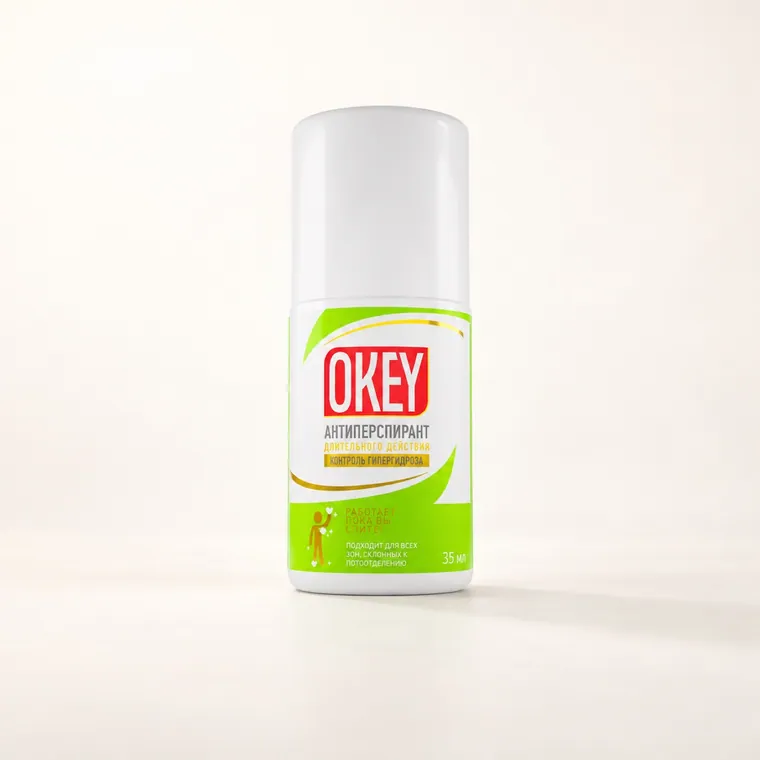
OKEY is a product of the team that owns this website. Its active ingredient is aluminum chloride in an aqueous solution, and it works as described above: it forms plugs in the ducts that wear off over time as the skin renews. That is why OKEY is designed for an evening routine: a thin layer on clean, completely dry and intact skin before bed, washed off in the morning; the stated effect lasts up to 72 hours, then use as needed. After hair removal or shaving, wait up to 48 hours. It contains no alcohol or fragrance, but has six care ingredients: aloe vera, panthenol, hyaluronic acid, chamomile extract, allantoin and glycerin. The 35 ml roll-on suits women and men and is for the underarms, palms, feet and other areas prone to excessive sweating. OKEY costs 7990 ₸ on Kaspi, and the bottle can be returned within 14 days.
Sources
- International Hyperhidrosis Society: antiperspirant basics — superficial plugs last at least 24 hours, stronger products step by step
- International Hyperhidrosis Society (for healthcare professionals): aluminum chloride — epidermal renewal, retreatment once or twice a week, overnight use
- International Hyperhidrosis Society: tips for best results with OTC antiperspirants — completely dry skin, bedtime application
- American Academy of Dermatology: hyperhidrosis treatment — bedtime application, maintenance, OTC products for mild hyperhidrosis
- Dermatology and Therapy (2016), Grabell & Hebert: current and emerging medical therapies for primary hyperhidrosis
- DermNet: hyperhidrosis — triggers and causes of secondary sweating
Try OKEY
A 35 ml roll-on with aluminium chloride, free of alcohol and fragrance, for women and men. Applied in the evening, with a claimed duration of up to 72 hours. The bottle can be returned within 14 days.