Fragrance in antiperspirants: who it bothers
A single word, Parfum, in an ingredient list can stand for dozens of substances. For most people it is just a scent, but fragrances are one of the most common causes of allergic dermatitis, and the underarms are one of the places where it shows. We explain what hides behind the word, who fragrance bothers and how to find it on the label.
What hides behind the word Parfum
Fragrance is usually listed with a single word — Parfum, Fragrance or Aroma. The FDA explains that fragrance and flavour ingredients may be listed on the label simply as Fragrance or Flavor: a scent formula can be complex and is treated as a trade secret. So one word can stand for a blend of many substances, and the label won’t tell you which of them make up the scent. This matters for anyone who has already reacted to perfumed cosmetics.
Why fragrance is added
Fragrance has two jobs. The first is to give the product a recognisable scent. The second is to mask the smell of the base and the active ingredients. The FDA specifically warns that a product labelled “unscented” may still contain a little fragrance — just enough to cover the unpleasant smell of other ingredients without giving a noticeable scent. So “unscented” on the pack and the absence of fragrance in the formula are not the same thing. Check the INCI list, not the promise on the front of the pack.
Fragrance and allergy
According to DermNet, fragrance allergy affects about 1% of adults and is the second most common cause of allergic contact dermatitis. Among people who undergo patch testing, about 10% show fragrance sensitivity. The typical picture is itchy, scaly red patches where the product touched the skin; the armpits are commonly affected in both women and men, and DermNet lists deodorants among the usual sources of fragrance. The allergy is not to the smell itself but to specific substances in the blend, so a reaction can appear even to a product a person has used before.
Fragrance allergens on the ingredient list
The EU Scientific Committee on Consumer Safety (SCCS) assessed fragrance substances that cause contact allergy in humans in its opinion SCCS/1459/11. Building on that work, the European Commission extended the labelling rules: Regulation (EU) 2023/1545 added another 56 fragrance allergens that must be named individually in the ingredient list when a leave-on product, such as an antiperspirant, contains more than 0.001%. From 31 July 2026, products that do not meet the new rules may no longer be placed on the EU market. On packs made under these rules, you may see names such as Limonene, Linalool, Citronellol, Geraniol, Citral, Eugenol, Coumarin or Benzyl Alcohol after Parfum. If you know your allergen, look for its name on the list.
Who fragrance bothers
Fragrance is worth avoiding if a doctor has confirmed a fragrance allergy, or if itching and redness have appeared after perfumed cosmetics before. A fragrance-free formula is a sensible choice for sensitive underarm skin and with regular hair removal, when the skin is more often irritated. It also suits people who wear perfume and don’t want scents to mix, and people sensitive to strong smells. Note that the word “hypoallergenic” has no common standard. The FDA says the term means whatever a particular company wants it to mean, and no substantiation is required. The ingredient list is a more reliable guide.
How to check the ingredients
Look for the words Parfum, Fragrance and Aroma in the INCI list, as well as the names of fragrance allergens. Keep essential oils in mind: scented plant oils are themselves made of aromatic substances — lavender oil, for example, contains linalool. At the same time, a plant extract on the list doesn’t always mean fragrance: some extracts are added as care ingredients, but they can also cause allergy. Check the ingredients on the pack of your own batch — DermNet notes that manufacturers can change ingredients without notifying consumers. If you have a confirmed fragrance allergy, discuss with a dermatologist how to test a new product before using it regularly. We cover reading the whole list in the article “How to read an antiperspirant ingredient list”.
OKEY: no fragrance and no alcohol
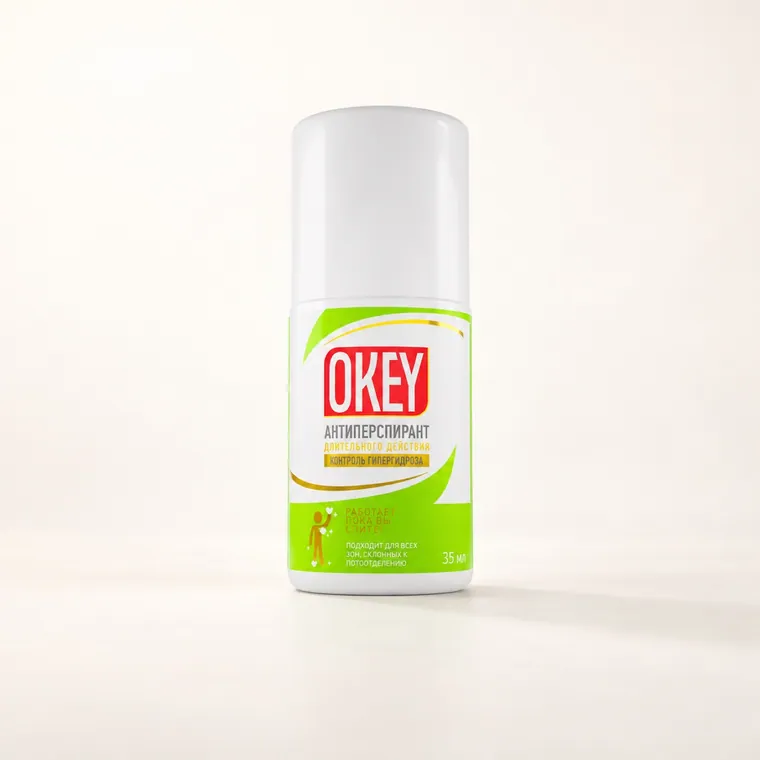
OKEY is made by the team that owns this site. It is a 35 ml roll-on for women and men with aluminium chloride in a water base, without fragrance and without alcohol. Its INCI: Aqua, Aluminum Chloride, Glycerin, Panthenol, Propylene Glycol, Chamomilla Recutita Flower Extract, Aloe Barbadensis Leaf Gel, Allantoin, Hyaluronic Acid, Hydroxyethylcellulose, Sodium Hydroxide, Phenoxyethanol, Ethylhexylglycerin. The list contains no Parfum, Fragrance or Aroma, and no fragrance allergens such as Limonene, Linalool or Benzyl Alcohol. Chamomile extract is one of the care ingredients, together with aloe vera, panthenol, hyaluronic acid, allantoin and glycerin; if you are allergic to chamomile or other plants of the daisy family, take it into account. OKEY is applied in the evening to clean, completely dry, unbroken skin and washed off in the morning; the claimed duration is up to 72 hours. You can try OKEY via the official site okeystaydry.com or the Kaspi link below; the bottle can be returned within 14 days.
Sources
Try OKEY
A 35 ml roll-on with aluminium chloride, free of alcohol and fragrance, for women and men. Applied in the evening, with a claimed duration of up to 72 hours. The bottle can be returned within 14 days.