How to choose an antiperspirant: roll-on, stick, spray, cream
The form itself doesn’t make an antiperspirant stronger or weaker: sweat is controlled by the active aluminium salt. But the form determines the dose, drying time, marks on clothing, comfort for sensitive skin and convenience on the road. We compare six forms against these criteria.
Active first, form second
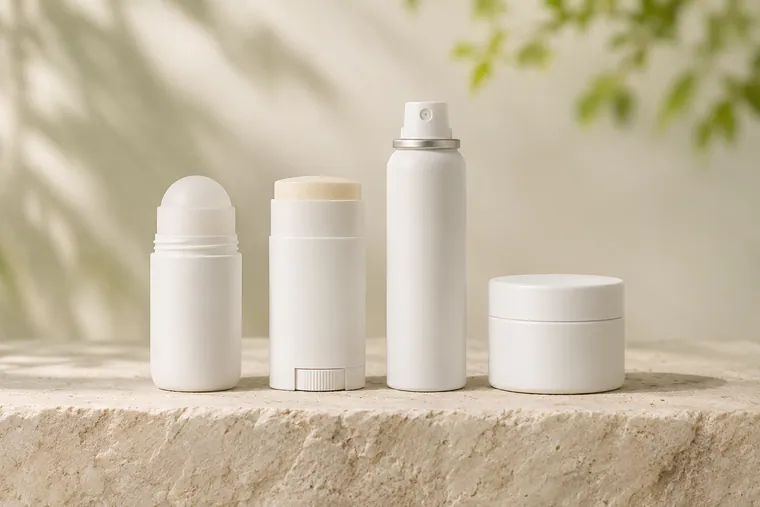
An antiperspirant temporarily reduces sweating where it is applied thanks to aluminium salts; a roll-on, stick or spray is just a way of delivering the active to the skin. Still, form and formula are linked. The US FDA monograph M019 allows aluminium chloride only in an aqueous, non-aerosol solution, and aluminium zirconium salts only in non-aerosol forms. That is why aluminium chloride products come as liquids — roll-ons, dab-ons and pump sprays without propellant — while aerosol cans use other salts, such as aluminium chlorohydrate. DermNet lists an even wider range of forms: cream, aerosol, stick, roll-on, wipes, powder and liquid applied with a brush.
Roll-on: a controlled dose
The ball lays down a thin film of liquid or gel, so the dose depends on the number of strokes: manufacturers’ directions most often call for 2–3 strokes per underarm. A roll-on makes it easy to apply the product precisely to the sweating area without touching the skin around it, and the bottle isn’t under pressure. The trade-off is drying time: a liquid needs a few minutes, and it’s best to dress only once the skin is completely dry. Roll-ons include both everyday products and night-time aluminium chloride formulas that are applied in the evening and washed off in the morning.
Stick: a solid base
A solid stick is held together by oils, waxes, fatty alcohols and silicones. It doesn’t drip, goes on quickly and usually needs no drying time. The downside is that a dense base shows up more on dark clothes and can leave white marks, which is why some sticks are designed to turn clear after application. Gel sticks work differently: they often contain water and alcohol, so they also need to dry before you get dressed.
Spray and aerosol are not the same thing
An aerosol sprays the product under pressure from propellants — usually liquefied gases such as butane, isobutane and propane. It dries quickly and doesn’t require touching the skin, but part of the product ends up in the air and the dose is harder to control. Shake the can, hold it at the distance stated on the pack, don’t spray near a flame and don’t inhale; the FDA monograph requires aerosol antiperspirants to carry a warning to keep the product away from the face and mouth. A pump spray is a different thing: it contains no propellants, it is a liquid in a bottle with a mechanical pump, and in composition it is closer to a roll-on solution.
Dab-on and cream
A dab-on is a bottle with a porous applicator used to dab the product onto the skin. This form is common for liquid aluminium chloride solutions, including alcohol-based ones, so following the directions on the number of dabs and the time of application is especially important. Cream, also on DermNet’s list, is applied with the fingers: the dose is hard to repeat consistently, and you need to wash your hands afterwards.
Travel and sensitive skin
When travelling, volume and packaging matter. A small bottle of up to 50 ml takes little space, while an aerosol can is pressurised, so check your carrier’s rules in advance. If a product is applied in the evening, you won’t need it in your bag during the day. For sensitive skin the form is secondary: alcohol, fragrance and the application routine matter more. For irritation, the AAD advises applying the product less often, trying a different form such as a gel, and applying it only to very dry skin. The general FDA monograph warnings are not to apply to broken skin and to stop use if a rash or irritation occurs. More in the article “How to choose an antiperspirant for sensitive skin”.
Why OKEY is a roll-on and how to try it
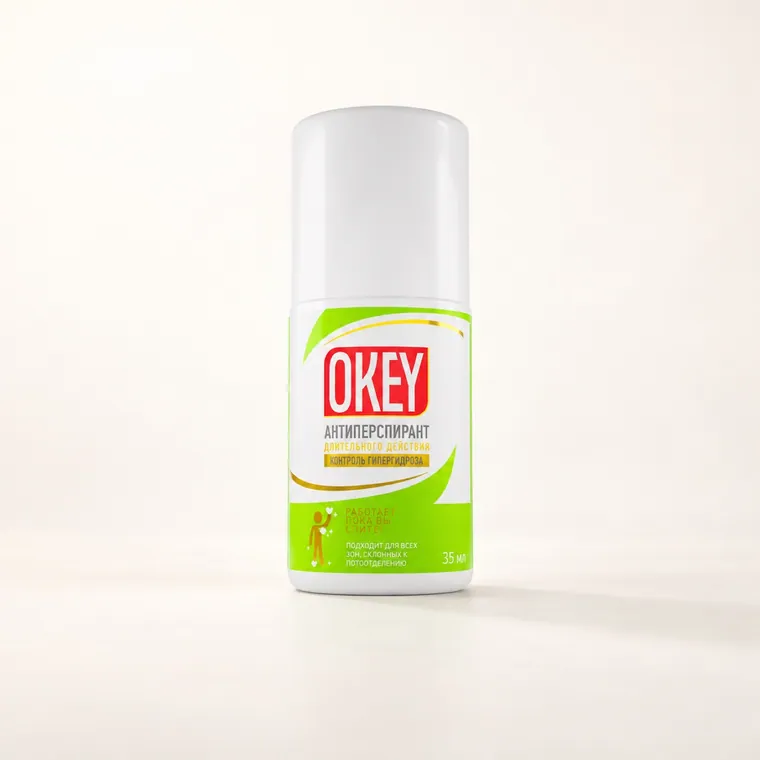
OKEY is made by the team that owns this site. It is a 35 ml roll-on for women and men, and against the criteria above it is built like this. The active is aluminium chloride in an aqueous solution, with no alcohol and no fragrance — exactly the non-aerosol aqueous form the FDA monograph provides for this active. The ball lets you control the dose and apply the product precisely to the underarms. The care ingredients are aloe vera, panthenol, hyaluronic acid, chamomile extract, allantoin and glycerin. OKEY is applied in the evening to clean, completely dry, unbroken skin, left overnight and washed off in the morning, so there is nothing to reapply during the day; the claimed duration is up to 72 hours. The compact bottle is easy to take on trips. You can try OKEY via the official site okeystaydry.com or the Kaspi link below; if it doesn’t suit you, the bottle can be returned within 14 days.
Sources
Try OKEY
A 35 ml roll-on with aluminium chloride, free of alcohol and fragrance, for women and men. Applied in the evening, with a claimed duration of up to 72 hours. The bottle can be returned within 14 days.