Propylene glycol in antiperspirant: what it does, who it bothers
Propylene glycol is one of the most common ingredients in cosmetics, and its name sounds alarming: it has "glycol" in it and something that sounds like alcohol. Here is why it is in antiperspirant, how cosmetic safety experts assess it, why dermatologists once named it allergen of the year and how to tell whether it does not suit you personally.
The short answer
Propylene Glycol is a solvent and moisture-retaining ingredient of the base: it helps dissolve other substances, holds moisture and affects texture. It is neither ethyl alcohol nor fragrance. The CIR Expert Panel found it safe in cosmetics formulated to be non-irritating. In a small share of people it causes irritation or allergy: in 2018 the American Contact Dermatitis Society named propylene glycol allergen of the year, not because it is dangerous for everyone but because it is almost everywhere. If your skin reacts, a dermatologist and a patch test can help find the cause.
What it does in a formula
In cosmetics, according to the CIR, propylene glycol works as a skin-conditioning agent, a solvent, a viscosity decreaser and a fragrance ingredient. In antiperspirants it is valued as a solvent and moisture-retaining ingredient: it helps make a clear gel or an even liquid in which the other substances are evenly distributed. It is also part of some aluminum zirconium salts: the letters PG in a name such as Aluminum Zirconium Tetrachlorohydrex PG mean a complex of the salt with propylene glycol; more on this in the article "Types of aluminium salts in antiperspirants: a table". Propylene glycol is also used in the food industry: US rules list it among food substances affirmed as generally recognized as safe, with limits on the amount for different food categories.
It is not alcohol in the everyday sense
Chemically, propylene glycol is a diol, that is, an alcohol with two hydroxyl groups, but it does not behave like ethanol. On the pack, ethyl alcohol is labelled Alcohol or Alcohol Denat., and that is what gives quick evaporation and a cooling feel and can sting on damaged skin. So propylene glycol in the ingredient list does not mean the product is alcohol-based, and an "alcohol-free" label does not mean there is no propylene glycol. More on alcohol in the article "Alcohol in antiperspirants: what it does and who it bothers".
What is known about its safety
In 2012 the CIR (Cosmetic Ingredient Review) Expert Panel reviewed propylene glycol, tripropylene glycol and polypropylene glycols and concluded that they are safe as used in cosmetic formulations when formulated to be non-irritating. Most of the data concerned propylene glycol itself: it is generally non-toxic and non-carcinogenic, and in clinical studies it did not cause skin sensitization at use concentrations, but irritation remained a concern. The CIR summary also gives figures. In some studies irritation appeared at 10% in a predictive test and at 2% in provocative tests, while in others even 100% did not irritate. Use studies of deodorants containing 35–73% propylene glycol in 24–40 volunteers showed neither irritation nor sensitization. In pooled patch test data from patients, no more than 6% of those tested reacted positively to a 30% aqueous solution.
Why it was named allergen of the year
In 2018 the American Contact Dermatitis Society (ACDS) named propylene glycol "Allergen of the Year". In the article explaining the choice, the authors describe it as an ingredient of cosmetics, medications and food and stress its dual nature: propylene glycol is both a weak sensitizer and an irritant, which makes a positive patch test hard to interpret. The title is given to draw doctors' attention to common hidden sources of reactions, not because the substance is dangerous for everyone. For most people propylene glycol in an antiperspirant is not a problem, but if there is a reaction, its cause is hard to find without a test.
If your skin reacts
If your underarms turn red, itch or burn after an antiperspirant, stop applying it: that is what the FDA monograph requires in case of rash or irritation. Check whether you applied the product to damp skin or right after shaving: these are common causes of stinging unrelated to any particular ingredient. If the reaction recurs with different products, write down the full ingredient lists of all those that caused problems and show them to a dermatologist. The doctor can arrange a patch test and, based on its results, tell you which ingredient to avoid. Do not conclude on your own that "propylene glycol is to blame" from a single overlap in ingredient lists. See a doctor straight away if blisters, weeping or severe swelling appear, or if the irritation lasts several days.
OKEY: what has been published about the formula
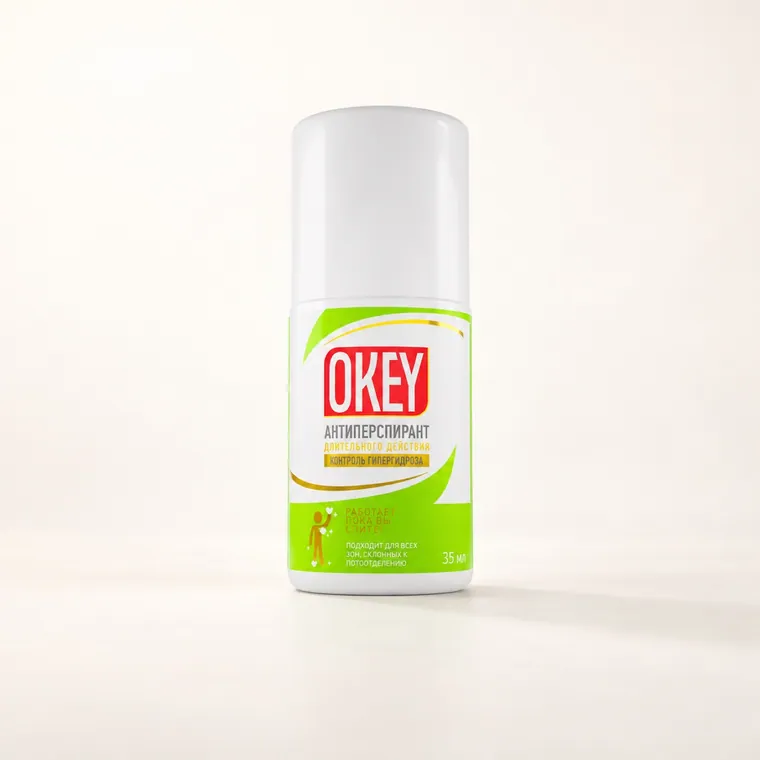
OKEY is a product of the team that owns this website. The official website okeystaydry.com states: the active ingredient is aluminum chloride, there is no alcohol or fragrance, there are six care ingredients — aloe vera, panthenol, hyaluronic acid, chamomile extract, allantoin and glycerin — and the texture is a light gel. The full INCI list is not given on the website, but if you need to compare it with your patch test results, it can be requested from the OKEY team through the official site. The product is applied in the evening, 2–3 strokes of the roller on clean, completely dry and intact skin, and washed off in the morning; the stated effect lasts up to 72 hours, then 1–2 times a week or as needed. After hair removal or shaving, wait up to 48 hours. The 35 ml roll-on suits women and men and is for the underarms, palms, feet and other areas prone to excessive sweating. OKEY costs 7990 ₸ on Kaspi, and the bottle can be returned within 14 days.
Sources
- Fiume et al., International Journal of Toxicology 31 (2012) 245S–260S: CIR safety assessment of propylene glycol, tripropylene glycol and PPGs
- CIR (2013): Safety assessment of alkyl PEG/PPG ethers — summary of the CIR propylene glycol data (deodorants with 35–73% PG, patch test data)
- Jacob, Scheman, McGowan. Propylene Glycol. Dermatitis 29(1), 2018 — ACDS Allergen of the Year
- 21 CFR 184.1666: propylene glycol affirmed as GRAS in food
- FDA OTC Monograph M019: warnings — rash or irritation
- Official OKEY website: light gel, alcohol- and fragrance-free; full INCI on request
Try OKEY
A 35 ml roll-on with aluminium chloride, free of alcohol and fragrance, for women and men. Applied in the evening, with a claimed duration of up to 72 hours. The bottle can be returned within 14 days.