Spray or roll-on: which works better
A spray feels more modern, a roll-on more reliable. In reality, sweating is reduced not by the packaging but by the active aluminium salt, which has to reach dry skin. But the form decides which active can be used at all and how much of the product reaches its target. We compare spray and roll-on purely on effectiveness.
The short answer
Neither form is stronger “by definition”. Effectiveness comes down to three things: which active and at what concentration, how much product reaches the skin, and what state the skin is in when you apply it. On the first two, sprays and roll-ons really do differ, as explained below. If you need an overview of all forms — stick, cream, dab-on — in terms of convenience, marks on clothes and travel, see the article “How to choose an antiperspirant: roll-on, stick, spray, cream”. Here we cover only what affects the result.
First, check which kind of spray you mean
The word “spray” covers two different devices. An aerosol is a pressurised can in which propellants, usually liquefied gases, push the product out. A pump spray contains no propellants: it is a liquid in a bottle with a mechanical sprayer, and in composition it is closer to a roll-on solution. In the rest of this article, “spray” means an aerosol: that is what the active-ingredient limits and warnings discussed below apply to. In terms of effectiveness, a pump spray is best treated as a liquid product — what matters is its active.
Which actives an aerosol can contain
This is where the roll-on has its main advantage. The US FDA monograph M019 allows aluminium chloride only in an aqueous, non-aerosol solution, and aluminium zirconium salts only in non-aerosol forms; a separate FDA rule (21 CFR 700.16) prohibits aerosol cosmetics containing zirconium. That is why aerosols use aluminium chlorohydrate and related salts — within a limit of 25%. DermNet notes that antiperspirants usually contain 10–25% aluminium salts, and the IHHS notes that prescription aluminium chloride solutions for the underarms usually contain 10–15% of the hexahydrate. If you need a night-time aluminium chloride formula or a product with an aluminium zirconium salt, it will be a roll-on, stick, gel or another non-aerosol form, not an aerosol.
How much product reaches the skin
A roll-on applies the product by contact: the dose depends on the number of strokes, and almost all of it stays on the skin in the treated area. An aerosol sprays from a distance; part of the cloud lands elsewhere or stays in the air, and the layer on the skin depends on the distance, how long you press and whether the can was shaken. So with the same active, a roll-on is easier to apply consistently day after day. The IHHS notes that gently massaging the product into the skin may be useful — with a roll-on, that happens by itself. To get the same precision from an aerosol takes discipline: hold the can at the distance stated on the pack and don’t cut the spraying time short.
Dry skin matters more than the form
Both forms work only on dry skin. The IHHS warns that applying to damp skin causes irritation and stinging, and advises drying the skin with a towel or a hair dryer on a cool setting if necessary. The AAD recommends applying antiperspirant at bedtime to dry skin and letting it dry completely. An aerosol dries faster, which is handy in the morning. A roll-on with a liquid solution needs a few minutes, but with evening application that costs nothing: the product dries before you go to sleep. Damp skin after a shower reduces the benefit of any form more than the choice between spray and roll-on does.
When a spray is handier, and when a roll-on is
A spray is convenient for large areas and places that are hard to reach with a roll-on: the AAD lists the back and chest among areas for antiperspirant, and the IHHS notes that aerosols are particularly useful for the feet. You don’t have to touch the skin with a spray, so it is easy to share. But the FDA monograph requires aerosol antiperspirants to carry a warning to keep the product away from the face and mouth to avoid breathing it. A roll-on is better where precision matters: underarms, palms, the spaces between the toes. It is also needed for evening aluminium chloride regimens that are applied overnight and washed off in the morning. For sensitive skin the form itself is secondary: alcohol, fragrance and skin dryness matter more.
How to compare two products by their labels
Compare specific products, not forms. Find the active ingredient — aluminium chloride, aluminium chlorohydrate or an aluminium zirconium salt — and its percentage if stated. Check which claims appear in the “Uses” section of a US label: in the US, “24 hour protection” and “extra effective” are tied to sweat-reduction tests. Read the directions: when to apply, whether to wash off in the morning, how often to repeat. Then test the result on yourself: the AAD says sweating is usually brought under control within a few weeks of regular evening use, so judging a product after one day is too early. More on duration in the article “How long does antiperspirant last: what 24, 48 and 72 hours mean”.
Why OKEY is a roll-on
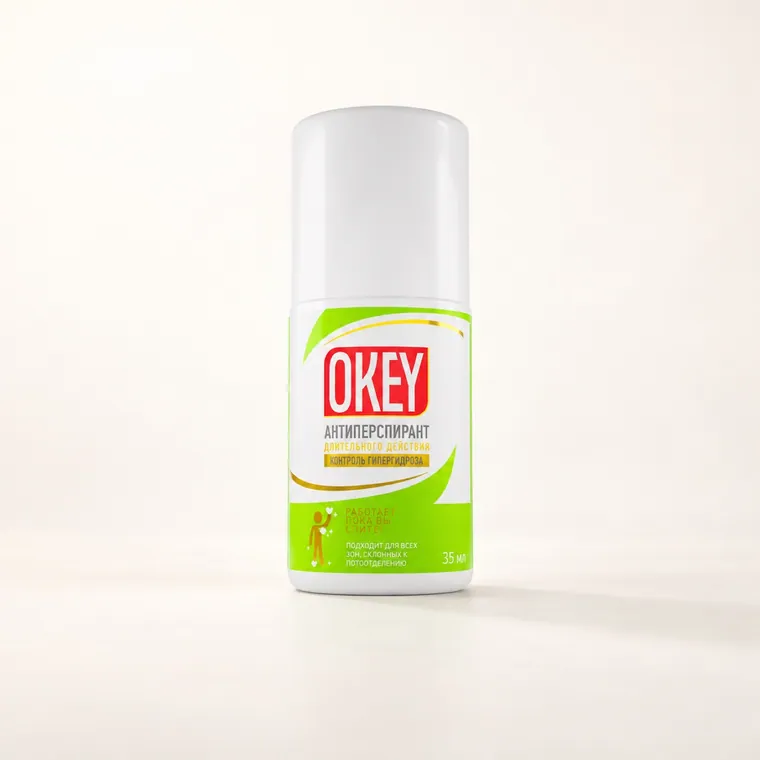
OKEY is made by the team that owns this site. Its active is aluminium chloride in an aqueous solution, and for this active the FDA monograph provides only a non-aerosol aqueous form — which is why OKEY comes as a roll-on. The ball lets you apply the product precisely to the underarms, palms, feet and other areas prone to excessive sweating, and repeat the same dose day after day. It contains no alcohol and no fragrance, but has six care ingredients: aloe vera, panthenol, hyaluronic acid, chamomile extract, allantoin and glycerin. OKEY is applied in the evening to clean, completely dry and unbroken skin, left overnight, washed off in the morning and then used as needed; the claimed duration is up to 72 hours. The 35 ml bottle suits women and men. You can try OKEY via the official site okeystaydry.com or the Kaspi link below; if it doesn’t suit you, the bottle can be returned within 14 days.
Sources
- FDA OTC Monograph M019: actives by dosage form, aerosol warnings, effectiveness claims
- 21 CFR 700.16: aerosol cosmetic products containing zirconium
- International Hyperhidrosis Society: tips for best results with OTC antiperspirants — dry skin, aerosols for feet
- International Hyperhidrosis Society: antiperspirant basics — strengths and prescription solutions
- American Academy of Dermatology: hyperhidrosis treatment — application and body areas
- DermNet: hyperhidrosis — antiperspirant formats and concentrations
Try OKEY
A 35 ml roll-on with aluminium chloride, free of alcohol and fragrance, for women and men. Applied in the evening, with a claimed duration of up to 72 hours. The bottle can be returned within 14 days.