Types of aluminium salts in antiperspirants: a table
Antiperspirant labels use more than a dozen names for aluminium salts. FDA monograph M019 groups them into a few families with different concentration limits and permitted forms. Below is a table by family: each row shows the salt’s INCI name, how much is allowed, which forms it comes in and how it is usually applied.
Row 1. Aluminium chloride
INCI name: Aluminum Chloride. FDA monograph limit: up to 15%, calculated on the hexahydrate. Permitted form: aqueous solution only, no aerosol — for example a roll-on or a liquid with an applicator. Typical routine: in the evening on completely dry skin, washed off in the morning. Cleveland Clinic describes aluminium chloride solutions this way: they are applied to dry skin, usually at bedtime, and mild irritation, redness and dryness are among the common side effects. It is the simplest salt in the table.
Row 2. Aluminium chlorohydrate and related salts
INCI names: Aluminum Chlorohydrate, Aluminum Dichlorohydrate, Aluminum Sesquichlorohydrate. FDA monograph limit: up to 25%, on an anhydrous basis. Permitted forms: aerosol and non-aerosol. Typical routine: daily, usually in the morning or after washing, unless the manufacturer states otherwise. The prefixes di- and sesqui- reflect a different ratio of aluminium to chlorine. Salts from this family are the ones used in aerosol antiperspirants: aluminium chloride and zirconium salts are not permitted in spray cans.
Row 3. Propylene glycol and PEG complexes
INCI names: Aluminum Chlorohydrex PG and PEG, Aluminum Dichlorohydrex PG and PEG, Aluminum Sesquichlorohydrex PG and PEG. FDA monograph limit: up to 25%, as for the parent salts. Permitted forms: aerosol and non-aerosol. The ending -hydrex and the letters PG or PEG mean the salt is bound in a complex with propylene glycol or polyethylene glycol. The principle is the same as for the whole table: the salt forms temporary plugs in the sweat ducts in the treated area.
Row 4. Aluminium zirconium salts
INCI names: Aluminum Zirconium Trichlorohydrate, Tetrachlorohydrate, Pentachlorohydrate, Octachlorohydrate and their glycine complexes ending in -hydrex GLY, such as Aluminum Zirconium Tetrachlorohydrex GLY. FDA monograph limit: up to 20%, on an anhydrous basis. Permitted forms: non-aerosol only — sticks, gels, creams, roll-ons. In the EU, Regulation No 1223/2009 limits these complexes to 20%, and 5.4% calculated as zirconium, and bans them in aerosols; in the US, cosmetic aerosols containing zirconium are prohibited by 21 CFR 700.16. More in the article “Aluminium zirconium in antiperspirants: how it works”.
What is not in the table
Not every word with aluminium in an ingredient list is an antiperspirant active. Alum — Potassium Alum or Ammonium Alum, used to make “crystal deodorants” — is not on the FDA monograph’s list of active ingredients. Aluminum Starch Octenylsuccinate is a modified starch that in cosmetics usually works as an absorbent and improves texture; it does not plug sweat ducts. If there is no other aluminium salt in the formula, you are more likely looking at a deodorant than an antiperspirant.
How to read percentages and order in a formula
The FDA monograph asks for the active percentage to exclude water, buffer components and propellant, so the figure in a US Drug Facts panel refers to the salt itself. In the EU no percentage is printed: ingredients are listed in descending order of concentration, and those below 1% may follow in any order. The closer a salt is to the start of the list, the larger its share of the formula, but the exact percentage cannot be worked out from the INCI. Remember too that the limit in the table is the permitted maximum, not the amount of salt in a particular product.
Safety: what the SCCS and the AAD say
In opinion SCCS/1662/23, adopted in March 2024, the EU Scientific Committee on Consumer Safety (SCCS) concluded that aluminium compounds are safe in non-spray cosmetics at the maximum levels given in the opinion’s tables, and in sprays at the same levels provided that particles and droplets smaller than 10 µm make up no more than 20% of all aerosolised particles. The AAD writes that research has not confirmed a link between aluminium antiperspirants and Alzheimer’s disease or breast cancer. The general rules are the same for every salt in the table: do not apply to broken skin, and stop use if a rash or irritation occurs.
OKEY: row 1 of the table
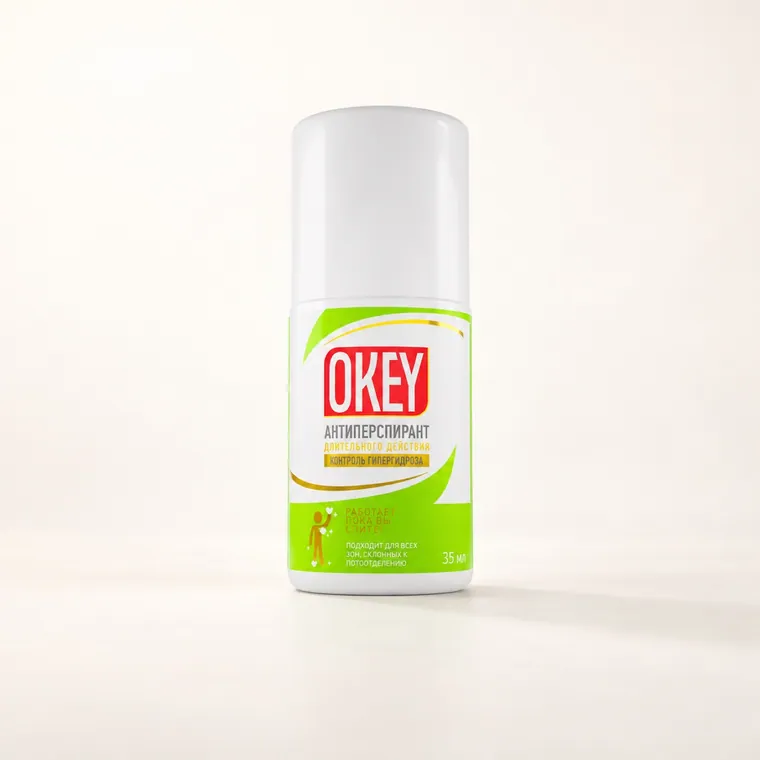
OKEY is made by the team that owns this site. Its active is aluminium chloride in a water solution — row 1 of the table and the aqueous non-aerosol form the FDA monograph provides for this active. OKEY contains no zirconium salts, no chlorohydrates and no alum; the full INCI: Aqua, Aluminum Chloride, Glycerin, Panthenol, Propylene Glycol, Chamomilla Recutita Flower Extract, Aloe Barbadensis Leaf Gel, Allantoin, Hyaluronic Acid, Hydroxyethylcellulose, Sodium Hydroxide, Phenoxyethanol, Ethylhexylglycerin. It is a 35 ml roll-on for women and men, without alcohol and without fragrance, with care ingredients: aloe vera, panthenol, hyaluronic acid, chamomile extract, allantoin and glycerin. The routine matches the row too: in the evening on clean, completely dry, unbroken skin, left on overnight and washed off in the morning; the claimed duration is up to 72 hours. After hair removal, wait up to 48 hours. You can try OKEY via the official site okeystaydry.com or the Kaspi link below; if the product doesn’t suit you, the bottle can be returned within 14 days.
Sources
- FDA OTC Monograph M019 (formerly 21 CFR part 350): active ingredients, limits and dosage forms
- 21 CFR 700.16: aerosol cosmetic products containing zirconium
- EU Cosmetics Regulation (EC) No 1223/2009, Annex III
- SCCS/1662/23: safety of aluminium in cosmetic products
- Cleveland Clinic: aluminum chloride topical solution
- American Academy of Dermatology: hyperhidrosis treatment
Try OKEY
A 35 ml roll-on with aluminium chloride, free of alcohol and fragrance, for women and men. Applied in the evening, with a claimed duration of up to 72 hours. The bottle can be returned within 14 days.