Antiperspirant during pregnancy: what is known
During pregnancy many people reread the ingredient list of everything they use, and an antiperspirant with aluminum salts is often the first product under suspicion. Here is what regulators' assessments and official medicine leaflets say about it, what nobody knows yet and why the decision stays with the doctor who manages your pregnancy. Why you sweat more during pregnancy in the first place is covered in the okeystaydry.com journal; this article is only about antiperspirant.
The short answer
The documents reviewed below contain no studies of antiperspirants in pregnant women. What exists are safety assessments for adult consumers in general. In 2020 the EU Scientific Committee on Consumer Safety (SCCS) concluded that aluminum compounds are safe in antiperspirants at up to 6.25% aluminum in non-spray products and up to 10.60% in sprays. The same year the German Federal Institute for Risk Assessment (BfR) called adverse health effects from daily use of antiperspirants with aluminum chlorohydrate unlikely. Neither document draws a separate conclusion about pregnancy. So the honest answer is: there is no evidence of harm, but there is no proven safety specifically in pregnancy either. The decision about any product belongs to the doctor who manages your pregnancy.
Where the worry came from
Antiperspirant is not the only way aluminum enters the body: the SCCS notes that diet is the main source for the population. The question is whether antiperspirant adds a noticeable share. For a long time there were no precise data. In 2014 BfR described the available results as contradictory, asked for new human studies and advised against applying antiperspirant right after shaving or to damaged underarm skin. That cautious assessment is still retold online as "aluminum from deodorant is dangerous", although new measurements have appeared since.
How much aluminum passes through the skin
Newer volunteer studies used an antiperspirant with aluminum chlorohydrate labelled with the isotope aluminum-26, which makes it possible to tell the applied aluminum from what is already in the body. Based on these data, the SCCS used an absorption fraction of 0.00052% of the applied aluminum on healthy skin for its risk assessment. The committee's conclusion: daily use of cosmetics does not add significantly to the overall aluminum burden from other sources. After these studies BfR revised its 2014 position and called harm unlikely, while noting that data for assessing many years of skin application are still insufficient.
Was the baby's development considered?
Indirectly, yes. The SCCS calculated its margin of safety from the level that caused no adverse effect in a neurodevelopmental study in rats: pregnant females received aluminum citrate in drinking water from day 6 of pregnancy and through lactation, and the offspring received it after weaning for almost a year. So the reference point was precisely the effect on development. But this was an animal experiment with aluminum taken by mouth, not an observation of pregnant women using antiperspirant. In addition, skin absorption was measured for aluminum chlorohydrate; these documents contain no such measurements for aluminum chloride in strong pharmacy solutions.
What pharmacy solution leaflets say
Strong aluminum chloride solutions are also sold as medicines, and medicines have official leaflets with a pregnancy section. In the British summary of product characteristics for a 20% aluminum chloride hexahydrate solution in alcohol, the "Pregnancy and lactation" section consists of one sentence: no special precautions. The Kaiser Permanente drug encyclopedia entry for an American solution of the same strength is more cautious: during pregnancy, use only when clearly needed and discuss the risks and benefits with your doctor; it is unknown whether it passes into breast milk, so consult your doctor before breastfeeding. On the labels of many strong cosmetic antiperspirants in our catalog, manufacturers also write: during pregnancy and breastfeeding, only after consulting a doctor. The difference between official texts about similar products is one more reason not to decide this on your own.
If your doctor agrees: how to apply
Apply antiperspirant only to clean, completely dry, intact skin: FDA monograph M019 requires the label warning "do not use on broken skin", and the leaflets of strong solutions add irritated or recently shaved skin. The AAD advises applying the product at bedtime and letting it dry completely. Use a thin layer: more product does not mean more dryness. Skin can become more sensitive during pregnancy, so start with infrequent applications; if burning, itching or redness appears, wash the product off and stop using it. If smells have started to bother you, choose a fragrance-free formula. The same FDA monograph requires the warning "ask a doctor before use if you have kidney disease"; if you have this diagnosis, mention it to your doctor separately.
When sweat is a reason to call your doctor
Antiperspirant only handles the cosmetic side of the problem: wet underarms, palms or feet. Do not use it to mask new symptoms. If sweating appears suddenly and comes with fever, chills, a racing heart, tremor, weight loss or heavy night sweats, call your doctor without waiting for a scheduled visit. More about these signs is in the article "When increased sweating is a reason to see a doctor".
Bottom line and OKEY
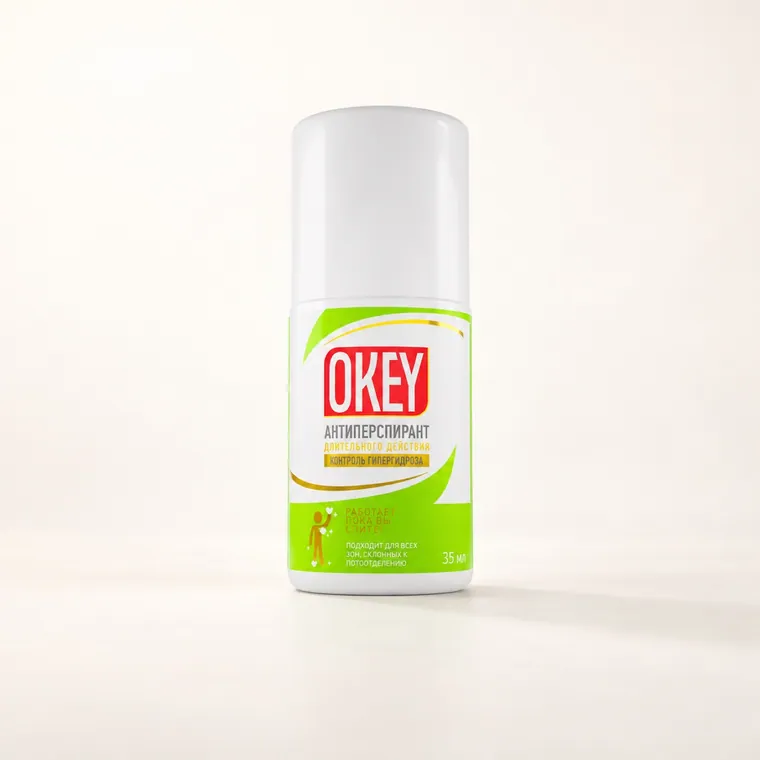
OKEY is made by the team that owns this site, so we will say it directly: we cannot claim that any antiperspirant, including OKEY, is safe during pregnancy. Show the doctor who manages your pregnancy the OKEY ingredient list and instructions. It is a 35 ml roll-on for women and men with aluminum chloride in an aqueous solution, without alcohol or fragrance; the latter matters if smells have started to bother you. It contains six care ingredients: aloe vera, panthenol, hyaluronic acid, chamomile extract, allantoin and glycerin. OKEY is applied in the evening in a thin layer to clean, completely dry, intact skin, washed off in the morning and then used as needed, usually once or twice a week; it suits the underarms, palms, feet and other areas prone to excessive sweating. If your doctor agrees, OKEY is available on Kaspi for 7990 ₸ with a 14-day bottle return; regular customers can order it on okeystaydry.com for 6990 ₸ with free delivery to a Flip pickup point, without a return option. Discuss every decision about products during pregnancy with your doctor.
Sources
- SCCS/1613/19: final opinion on the safety of aluminium in cosmetic products (2020) — conclusions
- SCCS/1613/19 full text: dermal absorption 0.00052%, neurodevelopmental study as the point of departure
- BfR: FAQ on the reassessment of aluminium in antiperspirants (20 July 2020)
- emc: SmPC of a 20% w/v aluminium chloride hexahydrate cutaneous solution — section 4.6 pregnancy and lactation
- Kaiser Permanente drug encyclopedia: 20% aluminum chloride topical solution — pregnancy and breastfeeding precautions
- FDA OTC Monograph M019: warnings — broken skin, kidney disease
- American Academy of Dermatology: hyperhidrosis treatment — bedtime application on dry skin
Try OKEY
A 35 ml roll-on with aluminium chloride, free of alcohol and fragrance, for women and men. Applied in the evening, with a claimed duration of up to 72 hours. The bottle can be returned within 14 days.