Antiperspirant for feet: how to choose and apply
Damp socks, slippery shoes and an odour that survives the wash are common companions of sweaty feet. Antiperspirant does not only work in the underarms: dermatologists use it on the feet too. We look at how to choose a product for the feet, how to apply it so that it works, and what to do about shoes and socks.
Why feet sweat
The feet have many sweat glands, and shoes and socks keep sweat from evaporating. According to DermNet, primary hyperhidrosis — excessive sweating with no other underlying disease — affects 1–3% of the US population and nearly always starts in childhood or adolescence. Sweating attacks can be triggered by hot weather, exercise, fever, anxiety and spicy food. The American Academy of Dermatology (AAD) explicitly lists the feet among the areas where antiperspirant helps with excessive sweating, alongside the underarms, hands, back, chest, face and groin.
Why constant moisture is a problem
Sweat itself hardly smells, but damp skin inside closed shoes is a comfortable environment for bacteria and fungi. DermNet lists the consequences of sweaty feet: unpleasant odour, ruined footwear, a tendency to a blistering dermatitis (pompholyx) and to secondary infections — athlete’s foot and pitted keratolysis, a bacterial condition that leaves small pits on the sole. The AAD advises slipping off your shoes whenever you can: this helps prevent odour, irritation and skin infections. So keeping the feet dry is not only about comfort but also about prevention.
How to choose a product for the feet
Only an antiperspirant reduces sweat — a product with an aluminium salt such as aluminium chloride or aluminium chlorohydrate. A deodorant without aluminium salts masks odour but does not keep the skin dry. The International Hyperhidrosis Society (IHHS) notes that the palms and soles usually need higher concentrations of the active than the underarms, and DermNet writes that separate products are made for different body sites, including the hands and feet. The format is a matter of convenience: the IHHS considers aerosols particularly handy for the feet, while a roll-on lets you place the product precisely between the toes. If your skin is sensitive, choose a fragrance-free formula: according to the IHHS, fragrances can cause dermatitis.
How to apply: step by step
1. In the evening, wash your feet and dry them thoroughly, especially between the toes. The skin must be completely dry: the IHHS suggests using a hair dryer on a cool setting if needed. 2. Apply a thin layer to the soles and between the toes — the IHHS names exactly these spots as the first to treat. 3. Let the product dry completely before going to bed; the AAD recommends applying antiperspirant to dry skin before bedtime. 4. Do not wrap your feet in plastic: according to the IHHS, this increases irritation without adding benefit. 5. In the morning, follow the directions of your product. According to the AAD, sweating usually comes under control within a few weeks, after which the product is applied as needed — usually once or twice a week.
Shoes and socks
Antiperspirant works better together with the simple habits the AAD recommends. Change your shoes and socks often and try not to wear the same pair two days in a row so that it has time to dry out. Choose shoes, including sandals, made of natural materials such as leather. Wear socks made of fabrics that wick moisture away from the skin; the AAD notes that bamboo does this naturally. Absorbent insoles and foot powder help too. And slip off your shoes when you can.
When to see a dermatologist
Do not apply antiperspirant to cracks, cuts or irritated skin: the FDA monograph requires the label to say “do not use on broken skin” and “stop use if rash or irritation occurs”. Peeling and cracks between the toes, itching, blisters or pits on the sole may mean athlete’s foot, dermatitis or keratolysis — these are treated by a doctor. It is also worth seeing a dermatologist when antiperspirant is not enough. For the feet, the AAD describes iontophoresis: the feet are placed in water through which a weak electric current passes; a session lasts 20–30 minutes, daily or once every 2–5 days, until sweating noticeably decreases — usually after 5–10 treatments — and the result is then maintained once a week or every other week. If sweating started suddenly, appears at night or comes with other symptoms, see a doctor.
OKEY for the feet
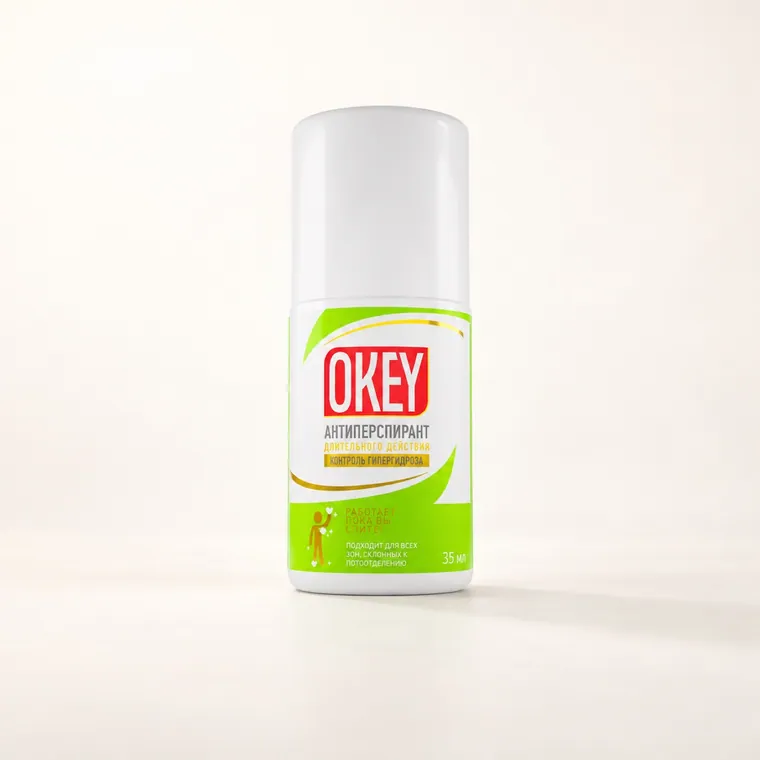
OKEY is a product of the team that owns this website. It is suitable for all areas prone to excessive sweating, including the feet and palms, and suits women and men alike. It is a 35 ml roll-on with aluminium chloride in an aqueous solution, which makes it easy to apply precisely to the soles and between the toes. It contains no alcohol and no fragrance, but has six skin-care ingredients: aloe vera, panthenol, hyaluronic acid, chamomile extract, allantoin and glycerin. According to its directions, OKEY is applied in the evening to clean, completely dry and unbroken skin, left on overnight and washed off in the morning, then used as needed to maintain the result; the claimed duration is up to 72 hours. If the skin of your feet is damaged or shows signs of fungal infection, see a doctor first. You can try OKEY through the official website okeystaydry.com or via the Kaspi link below; if it does not suit you, the bottle can be returned within 14 days.
Sources
- American Academy of Dermatology: hyperhidrosis treatment — antiperspirant areas, iontophoresis
- American Academy of Dermatology: hyperhidrosis self-care — feet, shoes and socks
- International Hyperhidrosis Society: tips for best results with OTC antiperspirants
- International Hyperhidrosis Society: antiperspirant basics
- DermNet: hyperhidrosis — plantar sweating and complications
- FDA OTC Monograph M019: warnings and directions
Try OKEY
A 35 ml roll-on with aluminium chloride, free of alcohol and fragrance, for women and men. Applied in the evening, with a claimed duration of up to 72 hours. The bottle can be returned within 14 days.