Antiperspirant for men: is there a difference
On the shelf, antiperspirants are split into men’s and women’s: dark and light bottles, “sport” and “floral” scents. But the rules that determine how strong a product is do not take the buyer’s sex into account. We look at where the difference is real, where it is only in the packaging, and what matters for a man choosing a product.
What actually differs
In the US, an antiperspirant is an over-the-counter drug, and its formula is governed by FDA monograph M019. It lists the permitted aluminium and aluminium-zirconium salts, their maximum concentrations and permitted dosage forms — one list for everyone, with no split between men and women. In the EU, antiperspirants are cosmetics and fall under Regulation (EC) No 1223/2009, where the restrictions on aluminium-zirconium salts do not depend on sex either. So the “men’s” and “women’s” versions usually differ in other ways: scent, bottle design, sometimes form and size. Strength is set by the active, its concentration and the directions, not by the colour of the pack.
The mechanism is the same for everyone
Aluminium salts dissolve in sweat and form temporary plugs in the sweat gland ducts where the product is applied. This mechanism does not depend on sex. The American Academy of Dermatology (AAD) describes one and the same routine for antiperspirants: apply to dry skin before bedtime and let the product dry completely, and once sweating is under control, continue as needed — usually once or twice a week. The result depends on how closely the routine is followed, not on who the bottle says it is for.
Do men sweat more
Partly yes, but not always. A review by Gagnon and Kenny in the Journal of Physiology (2012) found that at the same rate of heat production during exercise, women’s sweating is on average lower than men’s, and the difference appears only above a certain combination of heat and exercise intensity. On an ordinary day, the difference between two particular people is often larger than between the “average man” and the “average woman”. Excessive sweating — hyperhidrosis — is not only a men’s problem either: according to the AAD, anyone can develop it, and it is more likely in people aged 24 or younger and in those whose blood relatives sweated heavily.
Odour and fragrance
Fresh sweat hardly smells: odour appears when bacteria on the skin break it down. The strong fragrance that often sets men’s lines apart masks odour but does not reduce the amount of sweat. Fragrances can also cause allergy: according to DermNet, fragrance allergy affects around 1% of adults and, as a cause of allergic contact dermatitis, is second only to nickel. For body odour, the NHS advises washing your armpits with soap and drying them thoroughly, wearing natural fabrics, changing clothes regularly and using antiperspirants and deodorants. If your skin reacts to scented products, a fragrance-free formula is the sensible choice.
Underarm hair and shaving
An antiperspirant works on the skin, not on the hair. With thick hair, some of the product stays on it, so apply a thin layer so that it reaches the skin, and let it dry completely. The skin should be dry: the AAD notes that applying to dry skin reduces the risk of irritation. If you shave your armpits, the skin may be irritated or broken afterwards, and the FDA monograph requires the label to say “do not use on broken skin” and “stop use if rash or irritation occurs”. So a strong product is better applied not right after shaving but after the pause stated in the directions.
How to choose without looking at the pack
Check four things. The active: aluminium chloride, aluminium chlorohydrate or an aluminium-zirconium salt. The form: roll-on, stick, gel or spray — aerosols contain only salts of the chlorohydrate group. Alcohol and fragrance: these matter if your skin is sensitive or you shave your armpits. The directions: when to apply, whether to wash off and how often to repeat. If wet patches remain even with good hygiene, the NHS names stronger antiperspirants as one of the first steps, and advises seeing a doctor if sweating does not improve with self-care, has lasted at least 6 months or happens at least once a week and affects everyday life. If you suddenly start sweating much more than usual, that is also a reason to see a doctor.
OKEY: one bottle for men and women
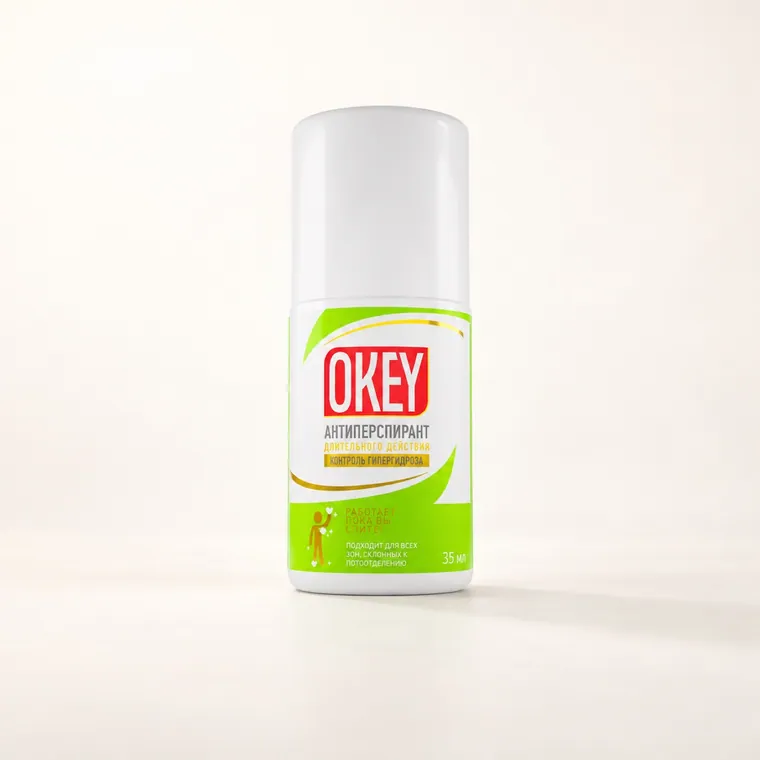
OKEY is made by the team that owns this site, and it is not split into men’s and women’s versions in the first place: one 35 ml roll-on suits women and men. The active is aluminium chloride in a water solution; it contains no alcohol and no fragrance but has six care ingredients: aloe vera, panthenol, hyaluronic acid, chamomile extract, allantoin and glycerin. The routine is the same for everyone: in the evening on clean, completely dry, unbroken skin, left on overnight, washed off in the morning, then used as needed to maintain the result; the claimed duration is up to 72 hours. After shaving or other hair removal, wait up to 48 hours. You can try OKEY via the official site okeystaydry.com or the Kaspi link below; if the product doesn’t suit you, the bottle can be returned within 14 days.
Sources
- FDA OTC Monograph M019: active ingredients, limits, dosage forms and warnings
- EU Cosmetics Regulation (EC) No 1223/2009, Annex III
- Gagnon D, Kenny GP. Does sex have an independent effect on thermoeffector responses during exercise in the heat? J Physiol, 2012
- American Academy of Dermatology: hyperhidrosis — who gets and causes
- American Academy of Dermatology: hyperhidrosis treatment
- DermNet: fragrance allergy
- NHS: body odour (BO)
- NHS: excessive sweating (hyperhidrosis)
Try OKEY
A 35 ml roll-on with aluminium chloride, free of alcohol and fragrance, for women and men. Applied in the evening, with a claimed duration of up to 72 hours. The bottle can be returned within 14 days.